Here you will find a scripture/story driven blog, that carries some ideas, reflections and, hopefully, the odd challenge.
Are you sitting comfortably...?
One dog and his man

Contents
June 2026
July 2026
September 2026
The Once upon a Time series no. 5: The Wild Goose Chase?
October 2026
Once upon a time, one chilly autumn morning an old was walking his dogs as the sun was beginning to shed its golden light across the fields. And as he walked he heard the sound of wild geese as they began to lift themselves from these maize fields that had recently been harvested for animal feed. At first there were just one or two, but soon the sky seemed to be full of these amazing birds. Full also of the cacophany of their loud honking as they were communicating to each other at the start of this new day.
Having spent the night in these fields they were now setting off on another leg of their epic journey back to their wintering grounds in the arctic circle, hundreds of miles away to the north. How do they find their way over such distances? A question that scientists are still struggling to definitively answer thought the old man.
On this particular morning, the old man noticed that there did seem to be a real intentionality in the behaviour of these wild geese. As they lifted themselves on their strong wings, they seemed to spend time getting their bearings as they circled above him, continually honking and squawking. Then before his eyes they began to form themselves into that all so familiar miracle of creation, the skein, their classic 'V' shaped formation, and off they flew. Finding their way step by step to their home in the north amongst the polar bears.
As he watched he became very aware of the way the skein was forming above his head. As he watched a single bird set off purposefully in a particular direction, honking as they went, the other birds fell into line. Some to the left and some to the right, but all pacing themselves so that the 'V' was formed before they made their way off to the horizon in in unison and in unity. Together in flight and together in purpose. And then as their sound gradually faded there was silence once more and the old man continued walking his dogs through the fields.
I am reminded here, sorry to say, of a stupid joke, do you want to hear it? OK if you insist. I once knocked over a goose that didn't get out of the way of my car quickly enough, fortunately for the goose I just clipped it and it was standing by the side of the road. I pulled over and walked back to see what damage I had inflicted on this poor creature. As I approached the goose looked up. For some reason I found my self saying, 'Are you a wild goose?' then to my amazement the goose replied, ' Wild, I'm furious!' and then it flew off.
Sorry, I did say it was stupid.
I am also reminded of a prophecy that was given once to my wife, she was told that she had the spirit of the wild geese. At the time this seemed a bit weird, a bit new agey, and we filed it under 'thanks but no thanks'. But what did the person mean by this? In what way might someone be seen to have the spirit of a wild goose?
Cutting to the chase, indeed, the wild goose chase, what a link! Perhaps, if you are still with me, we did dismiss this word too readily? I am actually reminded here iof some things that Jesus said,
The wind bloweth where it listeth, and thou hearest the sound thereof, but canst not tell whence it cometh, and whither it goeth: so is every one that is born of the Spirit. John 3:8
The way the idiom of a wild goose chase is commonly used is to describe something that is unreachable or even unknowable. To chase a wild goose is a forlorn chase that will ultimately end in disappointment. The reason being seems to be that the flight of these magnificent wild creatures is perceived as being too random and therefore any attempt to follow and try and work out which way to go in order that the geese might be caught is impossible. Suggesting that perhaps even the goose is not aware why it is flying in the direction in which it is flying.
However, as witnessed by the old man on this particular morning the behaviour of these wild geese was far from random. The geese rose in flight over these fields in order that they might be able to find the right direction in which they had to fly. This was not at all random. The way they had to travel that day was determined by their need to migrate to their winter feeding grounds and within them they mysterious have the capability to set the course in which to travel. This said, however, what the old man did notice is that on this particular morning one bird amongst the throng knew the way before the others. And seemingly in fluent goose he was telling his compatriots what this way was. Not only that he had the faith, he knew in his knower, and he took the lead to be the first to set off in this direction and then the others followed.
Here it comes! One two, three...altogether now...In the same way, when we set off in the morning to follow Jesus and to walk the path that he sets before us, we are told in this verse that we have something in us that will help us to follow His lead and this is His Spirit, who is alive and kicking in our spirit. And like the wind, and like the geese, this direction might seem at times a bit random, slightly unhinged and a trifle off the wall, but we know in our knower that we are following His lead and hopefully continuing to look into the face of Jesus, the author and finisher of our story and who is waiting to meet us at journey's end (see Hebrews 12:1,2).
We know that the geese are looking to reach their winter feeding grounds in the Arctic, but where are we being lead? Individually, the apostle Paul tells us the following,
For as many as are led by the Spirit of God, they are the sons of God. Romans 8:14
OK, as sons of God we are now leadable by the Holy Spirit, but where is He going to takes us? The verse before tells the place from which He wants to lead us,
For if ye live after the flesh, ye shall die: but if ye through the Spirit do mortify the deeds of the body, ye shall live. Romans 8:13
If we follow Him He will enable us to rise up and to leave for good the muddy fields of our flesh life, and then in the next few verses we are this wonderfulencouragement,
For ye have not received the spirit of bondage again to fear; but ye have received the Spirit of adoption, whereby we cry, Abba, Father. The Spirit itself beareth witness with our spirit, that we are the children of God: And if children, then heirs; heirs of God, and joint-heirs with Christ; if so be that we suffer with him, that we may be also glorified together. Romans 8:15-17
Our destination is glory, having passed through adopted sonship into the family of God along the way.
Perhaps we are now able to relate to the geese skein or 'V' in a new way? Who is the lead goose that knows the way we need to fly, the Lord clearly knows our way home and it is by His Spirit that we will surely complete the journey,however. Perhaps, in the here and now we do need to be part of a flock. We do need to travel home together with others. Cledarly, at times we do need to be around others who are able to speak into our lives and to pont us in the right direction. Perhaps the words of Jesus can help us here? He suggests that there is a someone who will need to be there to fly at the head of the skein?
If any man serve me, let him follow me; and where I am, there shall also my servant be: if any man serve me, him will my Father honour. John 12:26
As our flock rises to face the new day and to face all that the ravages of the end times might lie in store for us, we will need to look for His true servant, someone who is intimately connected with the Lord and who knows not just the way, but the truth and the life. The way to go, the truth to stand strong in and the life to be lead in these increasingly dark days. Follow the follower, don't trust your destiny to any one else! Serve the servant, find the leader with a servant heart, which is the heart of Christ, which we see here described by Paul,
But made himself of no reputation, and took upon him the form of a servant, and was made in the likeness of men Philippians 2:7
For us this leader, is a leader whothemselves are being made into the very likeness of Jesus. Indeed, a leader who will not be the paid hireling (see John 10:12,13) filling the pulpit with empty platitudes on a Sunday morning, but a leader who is cut from a different cloth and not necessarily a man of the cloth. When the Lord sent out the seventy to preach and teach about the kingdom in Luke 10, he gives an interesting instruction,
And into whatsoever house ye enter, first say, Peace be to this house. And if the son of peace be there, your peace shall rest upon it: if not, it shall turn to you again.
I apologise for taking this text out of its original context and I am not trying to sell you a pretext , but I believe that there is an interesting subtext at play here, And if the son of peace be there... What does Jesus mean by this? What He does seem to be suggesting is that as the seventy go out in twos to the surrounding towns and villages they will need to expect that they will not always be cold calling. On occasions they will find someone who is already on the way, a son of peace. This phrase is used uniquely here.
For our purposes I would like to say the following, I believe this is a time for a return to a relationally based expression of church life that neets in homes. And moreover, within these home fellowships the Lord will be preparing people to take on the mantle of leadership. Indeed, a servant hearted leadership that we have explored briefly above, and described here, as a son of peace. Why son of peace? The Lord's teaching in the beatitudes tells us that the final place of blessing that an individual will come to as they are transformed into the likeness of Christ, is to become as a true mature son of God (not 'child' as we have it in the KJV) , and as such they will become a peacemaker.
But the wisdom that is from above is first pure, then peaceable, gentle, and easy to be intreated, full of mercy and good fruits, without partiality, and without hypocrisy. And the fruit of righteousness is sown in peace of them that make peace. James 3:17,18
This is the quality of both disciple and leader that we need to follow. Why? They know the way home.
(An exhaustive biblical study of leadership can be found in my book, Taking the Form of a Servant, can be downloaded for free from the My Writing page on this website)
How smelly are you?
October 2026
What a rude question? Stay with me, I am sure you have had a shower sometime this month, no please don't lift your arm to check. The question that I pose is not to do with our physical wiff factor. I am talking here about the aroma of our spirit. Did you know that your spirit has a fragrance? Well it does as far as the apostle Paul is concerned.
For we are unto God a sweet savour of Christ, in them that are saved, and in them that perish: To the one we are the savour of death unto death; and to the other the savour of life unto life. And who is sufficient for these things? 2 Corinthians 2:15,16
This scripture came to mind when I remembered something that happened when my daughter Sophie was a toddler and into everything. On this particular day, we had invited a friend around to set us up with our very first home computer. We are going back into the mists of time here, back to the early nineties. This was very a exciting event, as you can imagine.
This friend was called Peter and he was one of a new breed, a computer programmer, oooh! And because his wife was at work he had to bring his own young child with him. This was fine, we thought, the two kids could entertain each other whilst the adults would then be free to play with their own new toy. We were in the kitchen of our new house and Peter was unveiling this new box of electronic tricks that would, we thought, revolutionise our lives: that is once we knew how to use it. Half an hour in and I thought 'the kids are quiet' and like in the movies this was followed by the next thought, 'too quiet'. We then noticed a strange fragrance filling the room. The unmistakeable sweet aroma of Johnsons baby talcum powder. Can you remember the smell, we certainly can.
I looked at Daniela, and she looked at me and we suggested to Peter that perhaps we ought to take a look at what the kids were doing. So tentatively we made our way upstairs to where we had left the two children, as we thought, playing nicely with Sophie's toys. What we found when we got to the upstairs landing was quite something else. The whole of the landing, including the two kids, was covered in a white blanket of sickly smelling Johnson's talcum powder. The kids were have a great time.
The moral of this story is don't ever leave your kids playing alone. No, obviously not, what could we do but laugh. The house had never smelt so good. However, in terms of how this informs us with regards to the challenging words of Paul, the moral here is that you have got to let it out. You have to open the bottle and spread the love. But first of all do we have enough love to spread?
Paul revisits this idea in another of his letters when he writes the following, again, challenging words,
Be ye therefore followers of God, as dear children. And walk in love, as Christ also hath loved us, and hath given himself for us an offering and a sacrifice to God for a sweet smelling savour. Ephesians 5:1,2
This scripture poses for us 3 questions:
- who and therefore how are we following ? And he said to them all, If any man will come after me, let him deny himself, and take up his cross daily, and follow me. Luke 9:23
- am I living as a beloved child? And there came a voice out of the cloud, saying, This is my beloved Son: hear him. Luke 9:35
- am I walking in love A new commandment I give unto you, That ye love one another; as I have loved you, that ye also love one another. By this shall all men know that ye are my disciples, if ye have love one to another. John 13:34,35 And this is love, that we walk after his commandments. This is the commandment, That, as ye have heard from the beginning, ye should walk in it. 2 John 1:6
Dare I ask again, how smelly are you?
What is the Point of Fellowship in the Gospel (2) What is Fellowship?
September 2026
This blog is the second to be taken from chapter 2 of the book, 'And the Point Is?', this book is downloadable for free from the My Writings page in this website.
What is fellowship? What is fellowship in the gospel?
Again, we might think we know what this term means. Perhaps, however, at this point it will be helpful to understand more clearly what the term 'fellowship' actually means within its usage in scripture. Essentially, the term fellowship is the translation of the Greek word ‘koinonia’. A word that literally carries a meaning of partnership and of a shared endeavour. Its specific meaning therefore within scripture will always be defined by its context. Therefore, the phrase to have fellowship in the gospel means that those involved are partners in this shared endeavour of the gospel. And this as we have seen in the first blog is a cyclical process. Indeed, a process for which we have been brought together as the body of Christ. And it is within this loving microcosm of humanity that the overarching purposes of God to gather a people for Himself bears fruit. Indeed, such a people who will be prepared and made ready to be a beautiful bride for His son and for His Kingdom to come, beyond this. And, as followers of Jesus in the here and now will be a true representation of His Kingdom rule of love on earth such that others are then added. Drawn like moths to the light of Christ and His love grace and mercy that shines forth out of the lives and hearts of those who are following the master. Those who have been fished become those who do the fishing. It is this endeavour in which we are to have fellowship, this is the gospel. This is the fellowship of the gospel.
In turning once more to teaching of Paul, we find a helpful description of just such a joint endeavour as he actively shares the gospel in first century city of Thessalonica, a city to be found in north east Greece even to this day. From the scriptural account of Paul’s mission to this city is in Acts 17 it seems to have been quite a troubled visitation, with the Jews reacting strongly against the message that Paul had brought to them. However, it is also clear that the gospel did bear significant fruit in the city,
And some of them (the Jews) believed, and consorted with Paul and Silas; and of the devout Greeks a great multitude, and of the chief women not a few. Acts 17:4
Those who had come through to faith at Thessalonica seem to have begun to meet in the home of a man called Jason who is then described as having suffered the wrath of the Jews. We are told that both him and his household were physically assaulted and dragged before the town council. What is interesting, however, is the way the Jews of Thessalonica, at this meeting before the city leaders, describe the impact of the gospel at this time, they say Paul and Silas with this gospel have ‘turned the world upside down…’[1]
It will be instructive and helpful to take some time unpicking the detail here.
But we were gentle among you, even as a nurse cherisheth her children: So being affectionately desirous of you, we were willing to have imparted unto you, not the gospel of God only, but also our own souls, because ye were dear unto us. For ye remember, brethren, our labour and travail: for labouring night and day, because we would not be chargeable unto any of you, we preached unto you the gospel of God. Ye are witnesses, and God also, how holily and justly and unblameably we behaved ourselves among you that believe 1Thessalonians 2:7-10
Paul was endeavouring to impact this community with the gospel and in this passage, we are given wonderful insight into the way he worked and the values that underpin his ministry.
- We were…
Paul was clearly not alone, we are told he came with Silas. He was working with others, there was active participation in the purposes of God by Paul and the community of believers that was being established in this particular Greek town and in the household of Jason. There was, therefore, fellowship in the gospel here. However, what form did this take?
- gentle among you, even as a nurse cherisheth her children
Paul goes on to describe their approach. The actual metaphor here is of a wet-nurse, i.e. as someone taking the place of a child’s mother to provide the sustenance of their own breast milk for the child. Paul is basically saying that they were able to provide the right spiritual food at the right time and in a form that was accessible for the people to whom they were communicating the gospel in Thessalonica.
- So being affectionately desirous of you
An approach motivated by hearts that are described here to have carried very strong feelings. Indeed, the Greek term used uniquely here is one that is usually associated with the longing of love.
- we were willing…
This translation does not express the full import of the Greek word used here. Paul is actually telling his readers that they actually had great pleasure in bringing to the place an heartfelt attitude of both love and spiritual zeal in Christ.
- …to have imparted unto you not the gospel of God only, but also our own souls
It was an experience that went beyond the mere words of the gospel, they were sharing the truth of the words from a more profound place, they were sharing their lives with those impacted within this community, why?
- because ye were dear unto us.
Why were Paul and his team doing what they were doing? There was clearly a strong relational connection between Paul, his team and the community within which they were working. Again, the Greek here is strong, the word translated as ’dear’ actually carries a meaning of dearly, well beloved, esteemed or even a ‘favourite’. It is the adjectival form of Agape and is the same word that Father God always uses of His own son Jesus in the synoptic gospels.[2]
- our labour and travail
This said, this undertaking was also demanding, strenuous and very full on, but because the motivation was one of love then the message was effectively carried through their perseverance and long suffering.
- Ye are witnesses, and God also, how… we behaved ourselves among you
The gospel is more than words, it has to be carried by the lifestyle of those who bring it.
- With holiness
- Justly
- With Blamelessness
In this, Paul and his team in Thessalonica were a manifestation of what Paul himself describes as the overarching aim and purpose for the people of God on earth and in society: not just sharing the gospel, but active, loving participation in the fellowship of the gospel. An aim and purpose wonderfully expressed by this verse,
…that ye may be blameless and harmless, the sons of God, without rebuke, in the midst of a crooked and perverse nation, among whom ye shine as lights in the world… Philippians 2: 15
This is fellowship in the gospel
As ye know how we exhorted and comforted and charged every one of you, as a father doth his children, That ye would walk worthy of God, who hath called you unto his kingdom and glory. For this cause also thank we God without ceasing, because, when ye received the word of God which ye heard of us, ye received it not as the word of men, but as it is in truth, the word of God, which effectually worketh also in you that believe. 1 Thessalonians 2: 11-13
In this, the second part of the same passage, Paul goes on to describe the method they had used in Thessalonica for the ongoing work of the Gospel as it impacted and transformed the lives of those that had been touched by it.
- how we:
- exhorted=to come along side
- comforted= to calm, console and encourage
- charged=literally to be a martyr for your sake
- every one of you,
In the Greek, the point that everyone no matter their gender, status or age were included is a very strong one. This gospel was universal and fully inclusive.
- as a father doth his children
Here, Paul demonstrates his underpinning heart felt motivation for delivering the gospel- it is the work of a loving spiritual father, a motivation that is expressed by these beautiful words,
For I am jealous over you with godly jealousy: for I have espoused you to one husband, that I may present you as a chaste virgin to Christ. 2 Corinthians 11: 2
The true purpose of the church and the ultimate context for the work of the gospel is to prepare and make ready a people for the return of the bridegroom, that is the bride. And here it is clearly expressed,
- That ye would walk worthy of God, who hath called you unto his kingdom and glory.
Indeed, this is the same ultimate purpose that is being described here by Paul, a walk worthy be called the bride of Christ,
- the word of God which ye heard of us, ye received:
- not as the word of men
- but as it is in truth
- the word of God
- which effectually worketh also in you that believe
The gospel is not just carried in words. However, the words which do carry the gospel must come from the heart of God, full of love and conviction, but never out of condemnation and brow beating. They must contain scriptural truth and focus on Jesus who is indeed this Truth. Then, Father has something to work with and which He then uses to start to work on us!. This is a spiritual dynamic that seems to be expressed here by the prophet Isaiah,
So shall my word be that goeth forth out of my mouth: it shall not return unto me void, but it shall accomplish that which I please, and it shall prosper in the thing whereto I sent it. Isaiah 55:11
A dynamic that Paul also describes here, we, each of us, whether we realise it or not, carry within us the spiritual seed of revelation of Christ and His love which we sow liberally through our words, actions and attitudes as we walk through this world, at times without realising it,
Now thanks be unto God, which always causeth us to triumph in Christ, and maketh manifest the savour of his knowledge by us in every place. For we are unto God a sweet savour of Christ, in them that are saved, and in them that perish: To the one we are the savour of death unto death; and to the other the savour of life unto life. And who is sufficient for these things? 2 Corinthians 2:14-16
However, in this wonderful endeavour we need each other to support us on the journey. Even Paul himself recognised how important this was for his own ministry,
And sent Timotheus, our brother, and minister of God, and our fellow labourer in the gospel of Christ, to establish you, and to comfort you concerning your faith… 1Thessalonians 3: 2
The point is… the fellowship in the gospel is a shared endeavour for the body of Christ within which we support and are supported to be an effective carrier of the presence of Christ and, therefore, by definition a sower of the seed of Christ. The method of sowing is through the whole of our lives. The quality and quantity of the seed which we sow will be determined by the quality of our heart and this in turn will be determined by the degree to which we are walking as true sons of God. This fellowship will be an expression of the wonderful true body of our dear Lord, as we work together in love and unity and most, importantly, in Christ.
Perhaps, to conclude this blog it would be timely to remind ourselves of the words of Jesus on the night in which He was betrayed, describing in His own words this fellowship in the gospel?
A new commandment I give unto you, That ye love one another; as I have loved you, that ye also love one another. By this shall all men know that ye are my disciples, if ye have love one to another. John 13:34,35
Amen.
[1] Acts 17:6
[2] See Matthew 3:17; 12:18; 17:5, Mark 1:11; 9:7; 12:6, and Luke 3:22; 9:35; 20:13
What is the Point of Fellowship in the Gospel (1)
What is the Gospel?
September 2026
This blog is taken from chapter 2 of the book, And the Point Is? (available to download free from the My Writings page of this website).
I thank my God upon every remembrance of you Always in every prayer of mine for you all making request with joy, For your fellowship in the gospel from the first day until now Being confident of this very thing, that he which hath begun a good work in you will perform it until the day of Jesus Christ Philippians 1:3-6
The phrase,‘fellowship in the gospel’ appears in scripture on just one occasion, and yet as a phrase it does seem to succinctly capture for us the essential function or point of the concept of fellowship that lies at the true heart of the life of the true church; wherever this might be found. Indeed, as expressed here Paul is describing the very impact of the fellowship in the gospel on the community of believers in Philippi. For him as the apostle who was called to carry the message of the cross as far into the Gentile world as the Spirit lead him, the gospel is the all-encompassing, ongoing work and ministry of Christ, on earth that is to occupy the life of the church from Pentecost[1] until the Lord returns for her as His bride. A work of God and of grace in which he exhorts the believers in Philippi to have total confidence. As we continue to move through this beautiful passage of Pauline writing one word calls out to us at every turn-LOVE. Paul has these spiritual brothers and sisters in his heart as they are held together by their shared fellowship in the gospel. He longs after them from the very deepest place of not just his being, but of Jesus in Him! He is eager that it is this love that pervades every aspect of their fellowship life, such that the delicious ripe fruits of righteousness hang low from the trees in the garden of their heart. And this love and these fruit bring us right back to where this all emanates- all this is by Jesus Christ, unto the glory and praise of God!
However, before we try to ascertain what the fellowship of the gospel might mean for us today and how we might know and move in such LOVE, let us explore how these two terms of fellowship and the gospel are to be understood through exploring their usage in scripture. Starting with the meaning of the word ‘gospel.
- What is the gospel?
What a stupid question, you may be thinking. Obviously, the gospel is the good news that Jesus died on the cross for our sins and offers us beyond the cross eternal life. However, by stopping here are we missing something that should be considered as an integral part of the gospel? We believe, therefore, it will prove useful to dig a little deeper into the word of God to see whether this might be true. As with most concepts within scripture it is often useful to start with their first occurrence in the word of God, this is the case here. For this we need to turn to Matthew 4 where we read the following,
And Jesus went about all Galilee, teaching in their synagogues, and preaching the gospel of the kingdom, and healing all manner of sickness and all manner of disease among the people. Matthew 4:23
The first mention of this term here does indeed provide us with its overarching context; the gospel will always be related to the kingdom. The Greek word that is translated as gospel actually does carry a meaning of ‘good news’, therefore, the gospel of the kingdom is the good news of the kingdom. Two further questions then follow: what is the good news and what is the kingdom?
The answer to these questions can be found in the message Jesus delivers a few verses earlier in Matthew, where we read the following,
From that time Jesus began to preach, and to say, Repent: for the kingdom of heaven is at hand. And Jesus, walking by the sea of Galilee, saw two brethren, Simon called Peter, and Andrew his brother, casting a net into the sea: for they were fishers. And he saith unto them, Follow me, and I will make you fishers of men. Matthew 4:17-19
Having been tested in the wilderness we have recorded here the moment at which this message of the gospel of the kingdom was released as Jesus begins to preach.[2]The message Jesus delivers has three distinct elements:
- Repent
- Follow me
- I will make you fishers of men
The context for these three elements is that the kingdom of heaven is at hand or not far away. Indeed, Jesus spends the rest of his ministry teaching his disciples about what it would mean for them to follow Him and thereby to become citizens of this new kingdom.
These three elements inform us that
- there is a point of entry to this kingdom, which is repentance,
- there is then an ongoing relational journey within this kingdom here on earth, as we follow Him wherever He decides to take us
- there is a process through which we become equipped and prepared to be citizens of this kingdom, which Jesus identifies as fishers of men.
This is the gospel of the kingdom. There is something clearly cyclical about this. We begin by being caught ourselves and we end up being able to catch others. However, once caught the crucial element that we all need to understand is the stage in the middle. We need to understand what it is to follow Jesus. We need to know personally what it is to be made into a fisher of men. What is the process? What is following Jesus?
For it is so important that we do understand these things because this is the essential message that Jesus came to bring, this is the gospel of the kingdom and He desires that this is the message that echoes down through ages throughout the whole world until His return, as we read near the end of Matthew's Gospel,
And this gospel of the kingdom shall be preached in all the world for a witness unto all nations; and then shall the end come. Matthew 24:14
However, what are we dealing with here? Is Jesus saying that we should all be standing on street corners shouting at people that the end is nigh? Lovingly informing anyone who happens to pass by that unless they repent they will go to hell? If this is what Jesus has told you to do then go for it. However, perhaps our approach to communicating the gospel of the kingdom might require more subtlety, love and hopefully a relational connection with those to whom we are sharing this good news. This would seem to be what Jesus had in mind, for at the end of this same Gospel we find Jesus’ final words to His disciples, where we read the following,
And Jesus came and spake unto them, saying, All power is given unto me in heaven and in earth. Go ye therefore, and teach (=to make disciples) all nations, baptizing them in the name of the Father, and of the Son, and of the Holy Ghost: Teaching (=to teach) them to observe all things whatsoever I have commanded you: and, lo, I am with you alway, even unto the end of the world. Amen. Matthew 28:18-20
On the other side of the cross Jesus leaves the disciples with His ‘power’ and the power described here is not the power of force, either temporal or spiritual, but that of authority[3]. We have been given Jesus’ authority to do two things: to make disciples and to teach them to follow Jesus. Significantly, we are not told to save souls or to bring individuals to repentance, this is God’s work. In terms of the three elements of the revealed gospel that we have been given in Matthew 4 the ongoing work of the disciples was to facilitate the replication of their spiritual reality in the lives of others and leave the rest to the Lord God. The key term here is facilitate, to oil the wheels of this journey for all those for whom the Lord might have given us opportunity and oversight with love.
What about the kingdom? After all, are we not told by Jesus that the kingdom is nigh? There are clearly two realities at work here, the now and the not yet. The actual kingdom over which Jesus will be King and ruling out of the tabernacle of David in Jerusalem during His Millennial reign is yet to come. However, the preparation for life in this kingdom began when Jesus began to preach concerning this kingdom. The ongoing requirement for us to follow Jesus is a twofold preparation, first of all to catch men today and for us to be made ready to be a citizen of Kingdom on Jesus’ return tomorrow. The key for both is expressed by Paul when he writes the following,
For the kingdom of God is not meat and drink; but righteousness, and peace, and joy in the Holy Ghost.For he that in these things serveth Christ is acceptable to God, and approved of men. Romans 14:17,18
The Kingdom of God is not physical but spiritual. It is now and yet, not yet. It is as we follow Jesus that we are transformed to carry His righteousness, His peace and His joy by which we are both prepared to catch men by the witness of His Spirit in our lives and also to be prepared for His kingdom for which we are required to increasingly carry his character and His nature as a true son of God. Thereby, being made both acceptable to God for the Kingdom and, also, approved of men as the good news they need to hear through our lives and not just our words.
The gospel or good news of the Kingdom that Jesus preached can therefore be understood as the good news that the Lord has an eternal plan for a spiritually enlivened and heart transformed humanity and that through God each of us can enjoy His gift of revelation of this for ourselves.[4] We say this because the important element that turns theory into practice, a dead religion into a living faith and head knowledge into heart transformation is revelation. A spark of heaven finding receptive kindling within the heart of man to create light. Let us remind ourselves of Jesus’ own words of loving heartfelt thanks to His Father,
At that time Jesus answered and said, I thank thee, O Father, Lord of heaven and earth, because thou hast hid these things from the wise and prudent, and hast revealed them unto babes. Even so, Father: for so it seemed good in thy sight. All things are delivered unto me of my Father: and no man knoweth the Son, but the Father; neither knowetthe Father, save the Son, and he to whomsoever the Son will reveal him. Come unto me… Matthew 11:25-28a
And let us remember Peter’s moment of God given insight,
He saith unto them, But whom say ye that I am? And Simon Peter answered and said, Thou art the Christ, the Son of the living God. And Jesus answered and said unto him, Blessed art thou, Simon Barjona: for flesh and blood hath not revealed it unto thee, but my Father which is in heaven. And I say also unto thee, That thou art Peter, and upon this rock I will build my church; and the gates of hell shall not prevail against it. And I will give unto thee the keys of the kingdom of heaven Matthew 16:15-19a
Indeed, what is the rock upon which the church will be built? The rock is the cornerstone of personal revelation of not just who Jesus is, but who Jesus is for me. The church is built on the rock of heart felt revelation not on Peter the pebble, as some would have it. To see the importance of personal revelation look at how Paul describes his own acquisition of the gospel,
But I certify you, brethren, that the gospel which was preached of me is not after man. For I neither received it (the gospel) of man, neither was I taught it, but by the revelation of Jesus Christ… Galatians 1:12
And notice how he also describes revelation of the gospel in terms of an internal light bulb receiving power for the first time in the following scripture. Indeed, without this light we cannot see the gospel, we are spiritually blind.
But if our gospel be hid, it is hid to them that are lost: In whom the god of this world hath blinded the minds of them which believe not, lest the light of the glorious gospel of Christ, who is the image of God, should shine unto them. 2 Corinthians 4:3-4
However, when revelation comes what a transformation!
For God, who commanded the light to shine out of darkness, hath shined in our hearts, to give the light of the knowledge of the glory of God in the face of Jesus Christ. But we have this treasure in earthen vessels, that the excellency of the power may be of God, and not of us. 2 Corinthians 4:6-7
Moreover, when the gospel has done its work, look at the impact,
For it is God which worketh in you both to will and to do of his good pleasure. That ye may be blameless and harmless, the sons of God, without rebuke, in the midst of a crooked and perverse nation, among whom ye shine as lights in the world…Let your light so shine before men, that they may see your good works, and glorify your Father which is in heaven. Philippians 2:13,15; Matthew 5:16
In Christ, we move from receiving the light of His revelation to being transformed into a point of that light. From which the light of the revelation of Jesus might emanate the reality of this revelation through our lives to a world lost in darkness. The gospel has done its work in us and through us is beginning to do its work in others. Again, as described by Paul,
Now thanks be unto God, which always causeth us to triumph in Christ, and maketh manifest the savour of his knowledge by us in every place.For we are unto God a sweet savour of Christ, in them that are saved, and in them that perish: To the one we are the savour of death unto death; and to the other the savour of life unto life. And who is sufficient for these things? 2 Corinthians 2:14-16
To help us understand this process more clearly let us explore the experience and example of Paul as we find it in His writings, beginning with his salvation and calling,
But I certify you, brethren, that the gospel which was preached of me is not after man. For I neither received it of man, neither was I taught it, but by the revelation of Jesus Christ. For ye have heard of my conversation in time past in the Jews' religion, how that beyond measure I persecuted the church of God, and wasted it: And profited in the Jews' religion above many my equals in mine own nation, being more exceedingly zealous of the traditions of my fathers. But when it pleased God, who separated me from my mother's womb, and called me by his grace, To reveal his Son in me, that I might preach him among the heathen; immediately I conferred not with flesh and blood…Galatians 1:11-16
Paul’s autobiographical description or testimony of his own calling is captured succinctly by the phrase that has been highlighted in the text. The whole of God’s dealings with this great man from the womb onwards can be summed up in the simple reality that God wanted to make him into a walking and talking manifestation of Jesus. God had so got hold of Paul’s heart, life and character that he was a carrier of the nature of Jesus and therefore because of this, he carried the gospel. and as we have seen above, this was totally due to the fact this had been received by revelation. The light we receive is the light that we are able to release. Indeed, in the passage above there is a four-letter word that explicitly expresses this reality; the word is ‘that’. Paul has the authority to preach Jesus among the heathen precisely because Jesus has been revealed in him. Without this his words would have been merely empty rhetoric, but with revelation they carry the power of God unto salvation.
For I am not ashamed of the gospel of Christ: for it is the power of God unto salvation to everyone that believeth; to the Jew first, and also to the Greek. For therein is the righteousness of God revealed from faith to faith… Romans 1:16,17a
The gospel, therefore, as described by both Jesus and then Paul is more than a message. It is a message that is underpinned by the quality of the messenger.
We do not just give the gospel we need to become the gospel.
Moreover, in this endeavour, we are not alone. We have been given a support network to help us on our way. This is why we are added into the body of Christ when we are saved. We are provided with a place of loving, supportive nurture, so that we can grow up in God. So that we can move from babes in Christ to become sons of God. So that we become fishers of men. This is just what Paul describes in his letter to the believers in Ephesus, where he writes the following,
Blessed be the God and Father of our Lord Jesus Christ, who hath blessed us with all spiritual blessings in heavenly places in Christ: According as he hath chosen us in him before the foundation of the world, that we should be holy and without blame before him in love: Having predestinated us unto the adoption of children by Jesus Christ to himself, according to the good pleasure of his will, To the praise of the glory of his grace, wherein he hath made us accepted in the beloved. Ephesians 1: 3-6
Just like with Paul, mysteriously, our destiny has also been preordained, even before the foundation of the world[5] we were chosen in Christ. And moreover, at the same time in the court of heaven we were given a wonderful destiny to become a son of God; a vessel fit for the master’s use, a vessel fit for the gospel. Indeed, this would be a salvation and destiny that would be worked out and supported within the beloved which is his church, the body of Christ on earth. This body, the body of Christ on earth is the fellowship in and of the gospel.
[1] See Acts 2
[2] It must be remembered that there had been a very significant precursor to this which was the ministry of John the Baptist who had been proclaiming the same message but his had been a work of preparation for Him who was to follow.
[3] The Greek word used here is exousia, see also John 1: 12
[4] See 1 Corinthians 2:10
[5] The phrase ‘from’ or ‘before the foundation of the world’ occurs eight times in the New Testament (Matthew 13: 35; 25:34; John 17:24; Ephesians 1:14; Hebrews 4:3; 1 Peter 1:20; Revelation 13:8; and 17:8). And through these we learn that the plan for the incarnation of Jesus Christ, the gospel and even our election in Christ, as we read in Ephesians 1, were decided upon by the triune Godhead within the pre creation court of heaven. The Greek word that is translated ‘foundation’ in all eight occurrences is katabole which can mean to inseminate, which suggests that this wonderful life giving plan was seeded into the very framework and fabric of creation. For more on this read ‘We Shall All Bear the Image of the Heavenly’ by the same author.
Shaken Because We Are Stirred
September 2026

Do you remember James Bond's corny catch phrase on how he preferred his martini to be served,' shaken not stirred'. A phrase that made the women swoon around him. Just a thought, can we be shaken without first being stirred? Or in the immortal words of Little Richard, no relation, there does seem to be a whole lot of shakin' going on in the world today. What about us? Are we feeling shaken or at least a little bit stirred by what's happening in the world? There is a scripture that does talk about being shaken and perhaps it will be helpful turn there to help us gain a perspective on the times through which we are living and perhaps hear what the Lord might be trying to say to us through His word. Let's turn to Hebrews 12.
I find Hebrews 12 quite the chapter. Having been impacted hugely by its powerful focus upon running the race of true discipleship, understanding the way of discipling under our loving Father God and our journey's end of producing the peaceable fruit of righteousness, my attention has been drawn to its culmination and to the challenge within it for us to understand something of the shaking that perhaps we are witnessing in some of the mad things that are taking place in the world. Norms and values disappearing out of the proverbial window and the darkening shadow of authoritarian rule coming ever closer to challenge the cosy thatched roofed libertarian arcadia that is Britain in 2026. However, perhaps we need to look a little more closely to see what the writer to Hebrews (surely it has to be Paul, doesn't it?) is actually saying at the end of this chapter. What or who is being shaken and why is the shaking taking place?
The chapter ends in the following way,
Wherefore we receiving a kingdom which cannot be moved, let us have grace, whereby we may serve God acceptably with rever ence and godly fear: For our God is a consuming fire. Hebrews 12: 28,29
Beyond and, importantly, through the shaking this is place the Lord desires us to find in Him. The author has been ploughing this particular furrow for the whole chapter. This is our race , we are running to become this version of ourselves. A version that Father will find acceptable. This is why Jesus went to the cross so that there would be a way back to an acceptable, fruitful relationship with Father for those who would walk this walk. And as we progress through Hebrews 12 we need to know that the chastisement is the shaking. The scourging is the shaking (see v.6). Why? Basically because he loves us too much to let us stay the same and,
...that we might be partakers of his holiness. Hebrews 12: 10c
I am sorry,why again is this important?
Now no chastening for the present seemeth to be joyous, but grievous: nevertheless afterward it yieldeth the peaceable fruit of righteousness unto them which are exercised thereby. Hebrews 12:11
And as the author moves us forward in this chapter he is continuing to develop the same idea that there is a price that needs to be paid, but it is a price very much worth paying. The reason being, he argues, that if we only realised who we potentially are within the plans and purposes of the Almighty. If we only realised what does actually lay beyond us in the unseen realm. And if we would only realise that this shaking is a crucial aspect of our preparation to play a role within this yet unseen reality. We are talking here about the Millennial reign of Christ and the eternal state beyond this. However, the amazing thing is, that what we are being told here is that our access to this reality has already begun.
However, before we get there. The author once again challenges us, using the Biblical example of the doomed Esau. What do we want? A soulish, selfish satisfaction in the here and now? Or are we able to exercise some level of spiritual deferred self-gratification, to hold firm and to walk the narrow way? As we have seen in verse 28 it is all about the staying in the grace of God. Dare we fail? Dare we miss the blessing?
Looking diligently lest any man fail of the grace of God Hebrews 12:15a
We need to truly know where we are placed in Christ, Paul describes it as being seated with each other and with Christ in heavenly places (Ephesians 2:6) and the author of Hebrews encourages us to,
... therefore come boldly unto the throne of grace, that we may obtain mercy, and find grace to help in time of need. Hebrews 4:16
When we reach toward Father out of our closet, out of our heart of devotion and faith, this is a conversation we are having in and with heaven. Paul tells us the same in his letter to the Church in Philippi,
For our conversation is in heaven; from whence also we look for the Saviour, the Lord Jesus Christ Philippians 3:20
The author in Hebrews 12 takes this and truly runs with it. Hey, Church do you want to know who you are tapping into when you pray ?And do you want to know something about what is going on behind the spiritual scenes? Let me pull back the curtain just a little,
But ye are come unto mount Sion, and unto the city of the living God, the heavenly Jerusalem, and to an innumerable com pany of angel. To the general assembly and church of the firstborn, which are written in heaven, and to God the Judge of all, and to the spirits of just men made perfect, And to Jesus the mediator of the new covenant, and to the blood of sprinkling, that speaketh better things than that of Abel. Hebrews 12:22-24
Wow, quite a picture that is painted here of this behind the scenes reality, it reminds us of the cloud of witnesses in verse 1 of this chapter. And interestingly the author is not referring to some future spiritual destination for us, that we might be able look forward to connecting with, no, the use of Greek here tells us that we are in the here and now. We are come, not we will come. This the already done and available second perfect tense, the same as the English perfect tense. This an available reality that we are tapping into.
It is a story of two mountains, the first, Sinai, was inaccessible and the second, Zion, awaits our bold, faith filled presence. The first a mountain of fear, the second a mountain of joy.
It is also a story of two voices. From one came a voice that echoed with thunder, from the other...? Here we are moving to the resolution of the authors purpose in spelling out these different realities. It is all about hearing the voice that is spoken out of Zion and obediently following the words that are carried by the voice. He has been saying nothing less all chapter.
It is the same voice that can shake the very foundations of the earth, that can also speak to our hearts to shake away the dross, the besetting sins that weigh us down. The voice of Jesus, the still small voice (see 1Kings 19), the sound of many waters and the flaming sword (see Revelation 1), it is the same voice. Indeed, the voice of the author and finisher of our story (see v. 2). Are we listening? Are we going to make the same mistake that those gathered round the first mountain made, and not find the rest, the way, the truth and the life in the grace of God that he had wanted for them. Or are we going to heed the call, to hear the voice and to be stirred sufficiently that we will submit to be shaken. If we do then a kingdom awaits,
Wherefore we receiving a kingdom which cannot be moved, let us have grace, whereby we may serve God acceptably with reverence and godly fear. For our God is a consuming fire. Hebrews 12:28,29
Once upon a time series no. 4: Are You a Phone that Needs an Upgrade (a tale of our time)?
September 2026
Once upon a time an old man decided that he wanted to upgrade his mobile phone. The reason being that the one gig he had on his contract was not cutting it any more. He needed a level of connectivity beyond WIFI that he was just not getting. He wanted to be able to use his sat nav in the car, to listen to podcasts on the go, to get the most from his pocket sized computer.
For years he had been a tech outlier, not too far short of tipping into phobic country. However, he could now see the value and was ready to move on up into the rarefied world of the not too much. He cautiously was willing to go to a mighty 5 gigs for no more than £10 a month. The question that now lay before him was, how?
He decided the obvious and simplest choice was to try his existing provider. So he visited the local high street outlet for this particular provider. At the counter he explained what he wanted to do and was shown to a desk where an expectant assistant was waiting. Having explained again what he wanted he waited for the twelve year old (there does come a time when it seems that twelve year olds are running the world) to show him what was available. On the other side of the desk fingers were dancing over the keyboard and after a few seconds, just like a builder he had once mistakenly employed, the young man gave a sharp intake of breath through his teeth and at the same time shook his head. He went on to turn the screen of his computer so that the old man could see the bad news for himself. The cheapest deal that he could offer was £12.99.
This was surely close enough to the old man's requirements but having been recently retired he thought that the extra £2.99 per month might be problematic for him, even though he knew it wouldn't. I don't know people are complicated and in the moment, in that moment the old man had reservations. Perhaps this whole thing was stupid, he had survived with 1 gig for so long, was he really a 5 gig sort of person.
In response to this reticence the young man gave out a hope filled 'Well...' and again his fingers flew across the keyboard and this time as he turned the screen towards the old man things had remarkably changed. There were all kinds of deals which would have been within the parameters set by the old man. And he said with relief and new found confidence in his current undertaking as he visually scrolled down the page on the screen, I think I will have that one pointing to a perfect 5gig for £10 offer. Again there was the sharp intake of breath from the young assistant, I am really sorry I can't offer you this deal in store. You will have to do it through your phone. In that moment the old man, understandably, suffered a range of thoughts and feelings. He was confused, frustrated and at the thought of having to do this over his phone a little bit fearful. And he did get a bit angry too. Never a good look. The young assistant did his best to explain apologetically how easy this would be. However, the old man left the store not convinced, as he huffed and puffed down the high street walking back to his car.
The old man waited a couple of days before summoning up the courage to follow through on the upgrade and using his phone to do this. He had rationalised the situation and despite his inbuilt apprehension he had decided that this was indeed simple, oh you foolish old man, because he could do this easily using the three or four digit number from his phone.
The phone rang and then a disembodied, clearly AI generated voice began to ask the old man some questions with regards to the purpose of the call he was making. It seemed to expect him to respond verbally to them. What was the purpose of his call? Obviously he knew what the purpose was but how could he formulate this in a pithy two or three word phrase that this robot on the other end might be able to understand. He tried 'increase...' then couldn't think of what to say next. He had another stab, this time he started with 'more gi...' he wasn't able to finish this phrase however before the robot was wondering what was taking so long and offered some helpful suggestions. The old man was grateful because he did indeed now have a form of words which would work. 'Upgrade my phone please' he said proudly. The robot replied ' upgrade your phone, is that right?' and the old man had no trouble with the next part, 'Yes' he said.
The disembodied voice then asked for the old man to give the number from which he was calling, he was given two options. He could carrying using his voice or he could use his keypad on his phone. Mistakenly, he chose the former. You can imagine. No matter how loudly and how clearly he tried to enunciate those eleven numbers the robot never quite got it. And because he had chosen this method of communicating he wasn't able to revert to using the key pad. Eventually the robot died, I mean gave up this approach and offered an alternative. The old man was informed that he would receive two text messages on his phone, one would be piece of general security information, but the second, the important one, would be a six digit one off security code that he could input using his keypad. This was bound to break the log jam, at last a light at the end of this phone shaped tunnel.
Sure enough the first message arrived and the old man was poised over his phone, he waited and waited but the robot couldn't wait and asked what was going and then the message came and the old man quickly typed in the six digits stumbling over them as he felt under immense time pressure, only to hear the voice tell him that they were sorry but there was something wrong and that a new number would sent. The same thing happened three times, the code never came through to the old man's phone in time before the robot decided they had to move on. The old man ended the call and quietly sobbed to himself.
Having finished therapy and received treatment for his phone related PTSD, the old man decided that he was not going to be defeated. He would get his phone upgrade and he would wear his 5 gig with pride, as long as he could get it for less than £12.99.
This time he braced himself as he dialled the four digit number on his phone and waited, there they were again the AI digital friend. This time however older and wiser he knew the phrase and he used the keyboard option to give his number. And having been unhelpfully given the option to use the number that he had just used, which would have made the next hurdle, the security questions, more user friendly, he found himself embarking on trying to get through the security questions. User friendly, if only . At least he was on his way to talk to a human, or at least a closely related species, a call centre operative.
Then, sadly, the problems truly began for him. The old man was calling the call centre of a huge national phone provider and yet the quality of the line, this line, and for the old man the only line that mattered at this moment was awful. There was a lot of 'are you there?', can you hear me? ' 'what did you say?', 'can you please repeat that?'. The old man was really struggling to hold it all together, he tried to remember the coping strategies that his counsellor had suggested he might utilise when facing this level of phone related angst, as tears welled in his eyes and the, all too familiar, feeling of out of control panic began to grow.
The old man tried to pull himself together, and he realised that within the speaker distortion he was once again being asked a series of questions related to security. The company he had called had, as all similar companies would have, a series of security hoops that needed to be gone through before any conversation about phone upgrades could take place. The person on the other end of phone, who had given her name but within all the stress the old man could not remember what she had said her name was. But what he did find annoying was that she had decided they were such good pals that she could call him by his first name. Anyway, focus he told himself, I have to make a choice now. My new found friend wants to know one of the following before our friendship can truly flourish. Either the make and model of my phone, let's not go there, no idea. His daughter had bought it for him, she thought it was about time that he joined the twenty first century equipped with a smart phone. The next possibility was the last three numbers of his bank account out which they were taking their monthly fee or a number that she had used on his phone recently. So the old man decided to give the numbers from his account, the last three no danger there, he thought. So he dug out his wallet from his back pocket, took out his card and inputted the three digits into the keypad on his phone. He then sat back and waited for his new friend to move the conversation on to the sunny uplands of talking about an upgrade on his phone.
What came next did surprise him, considering he was looking at his bank card which contained the number in question, the lady said 'sorry, that number is not correct'. The old man also said 'sorry', but his sorry carried a little more anger (never a good look) he went on, 'how can you say that, I have the card right here?' She said 'Sorry' again, there was a lot of apologising going on without anyone actually really apologising. Channelling his best inner one foot in the grave Victor Meldrew impression said, all together now, 'I don't believe it!'. He then said can I give you a phone number from my phone desperately wanting to move things on and to rid himself of what he was feeling, again the panic of losing control. OK the now not so friendly new friend replies. So he thinks he will play safe and give her the actual number of the local high street outlet for this company he was now grappling with. A number he had used a few days before this call. He once again inputs the number taken from his very own call log on his phone into the keypad and once again waits. Can you guess what the call centre operator says next? Sorry, that is not a number we have here. WHAT!!! The old man ended the call.
Two weeks later, the old man was in Church and he got chatting to an old acquaintance. He had calmed down by this stage and began to relate his experience at the hands of big phone tech to his fellow pew dweller. His friend, who was of a similar vintage to the old man, told him that he was with a small company and that for it worked out very well for him, very stress free. This was music to the old man's ears , as was what he said next, it had been so simple to not only upgrade but to switch to them. He said that you do it online and they have streamline things so with little more than three clicks they would do the rest. Why not give it go, he suggested.
Then, to the old man's astonishment, that morning the vicar began his sermon with these words, And Jesus says 'come to me, all you who are weary and heavy laden and I will give you 5 gig'. He clearly didn't say this, but this is what the old man heard. And indeed, he does now have the gigs he wants and at an amazing price too. And it was all so easy.
Our spiritual connectivity with God is also a very important for us. The call that is on each of our lives is to carry His presence each and every day into our lives and through this to bear fruit for Him. How is our connectivity? What contract do we have with Father. The good news is that in his Son, Jesus Christ, He has paid the price for our connectivity. There is no need to negotiate a deal, that would be religion and that would never work anyway. The Lord is calling us to enjoy the best WIth FaIth connection to Him and His ongoing purposes. Below is an extract from my book, 'We Shall also Bear the Image of the Heavenly' which explores the issue of our connectivity in Christ.
As a son of God, a mature follower of Jesus who is walking after the Spirit in obedience, we have to stay close. So close, in fact, that it is just like being physically connected. Abide in me, and I in you.
Abide in me, and I in you. As the branch cannot bear fruit of itself, except it abide in the vine; no more can ye, except ye abide in me. I am the vine, ye are the branches: He that abideth in me, and I in him, the same bringeth forth much fruit: for without me ye can do nothing. John 15:4-5
We can hear echoes of the call to only do what we see the Father do here, but we are not Jesus. He could do nothing except what He saw the Father doing, we, however, can do nothing without Him. Notice Jesus’ actual words here, we abide in Him and He by His Spirit abides in us- it’s a double abiding, how close is that?
This is the level of connectivity that we need to walk fruitfully. It is as though Jesus could operate on Wi-Fi mode with His Father, however, we need to be plugged in to Jesus to achieve the same level of fruitfulness. We need the direct life giving enrichment of the sap of the Lord through His Spirit to maintain our healthy level of fruitful endeavour in Him. Jesus continues,
If ye abide in me, and my words abide in you, ye shall ask what ye will, and it shall be done unto you. Herein is my Father glorified, that ye bear much fruit; so shall ye be my disciples. As the Father hath loved me, so have I loved you: continue ye in my love. If ye keep my commandments, ye shall abide in my love; even as I have kept my Father's commandments, and abide in his love. John 15:7-8
he fruit will flow and the prayers will be answered as we live out of the vine, connected to the life source of the Lord and thereby to follow His commands and to keep His commandments.
I am the bread of life
I am reminded by this teaching in the upper room of another time when Jesus gives some very challenging teaching related to Him being the bread of life from John 6. We are told that Jesus is speaking on the sabbath in the synagogue in Capernaum. Prior to this, He has fed the five thousand on the far side of the lake of Galilee before walking part way across the lake, literally, returning with His, no doubt, shaken disciples to the town where He has based His ministry. We can imagine them thinking to themselves, ‘did that really just happen or was it a dream?. Here, He we find Him being challenged about the mass feeding event that had just happened across the water. Jesus immediately focuses their thoughts away from the physical to the spiritual reality of which the miraculous picnic had merely been a sign. He, Jesus, was and is all the spiritual sustenance anyone will ever need. As an event the feeding of the five thousand captured in the imagination of the those present the gift of manna that had fed the children of Israel as they had made their arduous way towards their promised land across the Wilderness of Sin during the exodus. And Jesus used this to develop his teaching that he in effect in the true manna, the bread of life for all mankind.
He says, Labour not for the meat which perisheth, but for that meat which endureth unto everlasting life, which the Son of man shall give unto you: for him hath God the Father sealed. John 6:27
There is, therefore, a form of spiritual sustenance that comes from Jesus, who is the Son of man, that, if taken, will enable that person to endure to eternal life.
And Jesus said unto them, I am the bread of life: he that cometh to me shall never hunger; and he that believeth on me shall never thirst. John 6:35
Jesus identifies Himself here as the new manna and as such He is the bread of life; the spiritual food that will, when taken, satisfy every spiritual hunger or thirst.
Then Jesus said unto them, Verily, verily, I say unto you, Except ye eat the flesh of the Son of man, and drink his blood, ye have no life in you. John 6:53
Jesus states here that as the bread of life it is His own flesh and blood that is offered as this spiritual sustenance that will provide this spiritual life. This is obviously suggestive of the communion sacrament that will be part of the life of the body, however, might it be something more?
He that eateth my flesh, and drinketh my blood, dwelleth in me, and I in him. John 6:56
As we have seen in John 15 there is a dwelling aspect to this, Jesus seems to be offering here a constant life giving provision of spiritual sustenance, we are called to live in the flow of this, the bread of life. The clincher being that the Greek word translated ‘to dwell’ here is the same word that is translated ‘to abide’ in John 15. And Jesus goes on to say the following,
As the living Father hath sent me, and I live by the Father: so he that eateth me, even he shall live by me. John 6:57
Again, as we have seen in Jesus’ teaching in the upper room, Jesus was able to be sustained through his Wi-Fi whereas we need to be hard wired. He had Father, we have the Lord through the vine and the bread of life. Does Jesus say anything different to His disciples in the upper room?
Abide in me, and I in you. As the branch cannot bear fruit of itself, except it abide in the vine; no more can ye, except ye abide in me. I am the vine, ye are the branches: He that abideth in me, and I in him, the same bringeth forth much fruit: for without me ye can do nothing. John 15:4,5
Is Your Heart Safe?
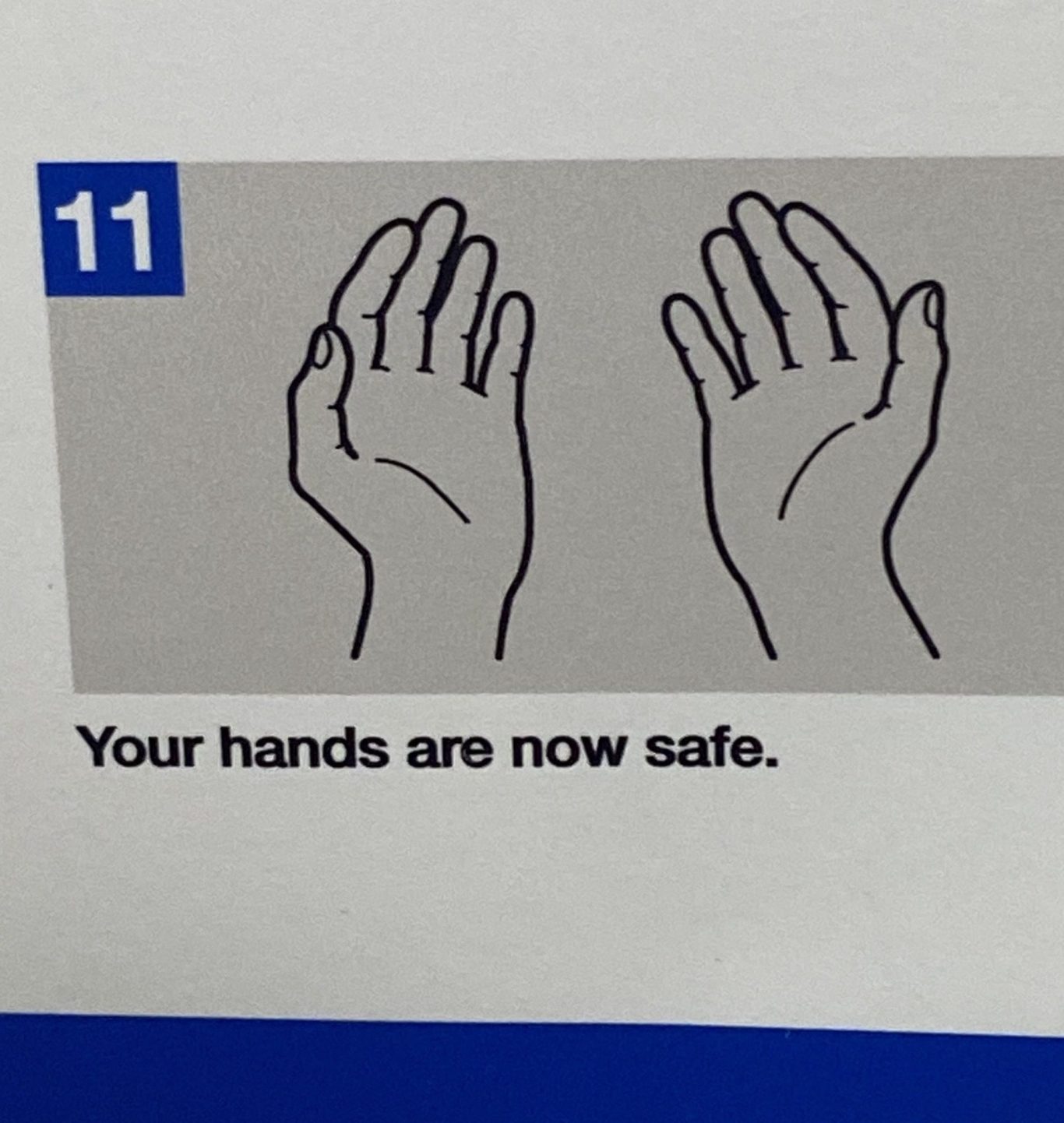
September 2026
I recently noticed a sign (see above) that had been placed above a sink in a men's room that I was using. The sign had been placed their a few years ago during the recent Covid outbreak. It is like many similar notices from this time which are giving us the information we need to wash our hands thoroughly thereby protecting anyone for whom we might come into physical contact. What I noticed is the wording attached to the final window. The window showed a pair of newly cleaned hands and the caption read, 'Now your hands are safe ', not just clean but safe.
I found that an interesting idea that I now , if I followed the steps outlined on the sign, would have a safe pair of hands. This is actually a phrase that is used in common parlance today , to have a safe pair of hands. It usually is applied to someone boring who is promoted to steady the ship if a political party, for example, has gone through a turbulent time. Sir Keir Starmer was the most recent example of this idea, it didn't work out too well for him however. Perhaps his hands were too safe or not safe enough, we will never know.
However, in reality will just wate and soap alone ever make someone's hands safe. No matter how clean our hands might be on the outside, can they ever be truly safe. The problem for our hands and every part of our physical body is not so much how clean they are, but rather how clean are the elements of who we are that might control our hands, feet or whatever bit of our body is called into action. Here I am talking about not just our minds. What is is that even controls our thought life, which thereby in turn will direct our physical actions.
It is all about the heart
James puts it scarily like this,
Let no man say when he is tempted, I am tempted of God: for God cannot be tempted with evil, neither tempteth he any man: But every man is tempted, when he is drawn away of his own lust, and enticed. Then when lust hath conceived, it bringeth forth sin: and sin, when it is finished, bringeth forth death. James 1:13-15
It is so important that we do sort out with the help of Father God, what lurks in the deep places of our being, otherwise known as our heart. The stuff that will trip us up comes from within, Jesus says the same as James,
Do not ye yet understand, that whatsoever entereth in at the mouth goeth into the belly, and is cast out into the draught? But those things which proceed out of the mouth come forth from the heart; and they defile the man. For out of the heart proceed evil thoughts, murders, adulteries, fornications, thefts, false witness, blasphemies: These are the things which defile a man: but to eat with unwashen hands defileth not a man. Matthew 15:17-20
Clearly for Jesus it is more than having safe hands that is at stake for all of us.
We need to have a safe heart.
And just like the notice on the wash room wall, we need to follow the instructions, and not just any instructions, these come from the maker Himself,
Blessed are the poor in spirit: for theirs is the kingdom of heaven. Blessed are they that mourn: for they shall be comforted. Blessed are the meek: for they shall inherit the earth. Blessed are they which do hunger and thirst after righteousness: for they shall be filled. Blessed are the merciful: for they shall obtain mercy. Blessed are the pure in heart: for they shall see God. Blessed are the peacemakers: for they shall be called the children of God. Matthew 5: 3-9
The Lord has given a very helpful way of understanding the beatitudes. The idea we will be working with is the redeemed human heart can be likened to a garden. And not just any garden, for us it is the garden of the Lord; our very own Eden. Just as Father God formed the first man and placed him in a garden, so with us he places a garden in us within which a man will be formed. And not just any man, no this man is the image and likeness of His son, Jesus.
And we know that all things work together for good to them that love God, to them who are the called according to his purpose. For whom he did foreknow, he also did predestinate to be conformed to the image of his Son, that he might be the firstborn among many brethren. Romans 8:28,29
After all, who is the one man to have walked the earth who we can be sure had a safe heart? For us the process will be one redolent of horticulture. First, the ground of our hearts will need to be cleared and any deep rooted weeds removed , this might be painful and even elicit a sence of loss or even mourning. However, these self serving soulish invaders of our hearts need to be removed so that the soil of our hearts might be prepared for the seeds of life and fruitfulness might then be sown by Father.
And he said to them all, If any man will come after me, let him deny himself, and take up his cross daily, and follow me. Luke 9:23
This will then be followed by a process of replanting the garden with self less meekness, Godly apetites and heart softening mercy. All of which will lead to a change in the quality of our hearts such that they will now be safe, or as described by Jesus 'pure'. So pure in fact that we might at last be truly able to see the Father at work in and through our lives and to see Him at work in the lives of those around us. So much so that we will begin to truly make a difference as we sow seeds of shalom into the daily realities of our lives.
But the wisdom that is from above is first pure, then peaceable, gentle, and easy to be intreated, full of mercy and good fruits, without partiality, and without hypocrisy. And the fruit of righteousness is sown in peace of them that make peace. James 3:17,18
Amen
A full teaching on the heart as a garden can be found in the book 'We Shall also Bear the Image of the Heavenly' available free to download in the My Writing section of this website.
9see above)
Once upon a time series no.3: The Pony and Her Water
August 2026
Once upon a time a man was walking his two dogs with his wife and two grandaughters on a very hot summers day. The summer had been so hot even in the usual cool climes of his particular part of the country, that the blackberries were already juicy, ripe and ready for picking. So, armed with a plastic tub, his wife and two grand daughters were busy picking the berries that they were planning on turning into wonderful blackberry jam later in the day.
Leaving them to get on with this, the man walked on with his dogs. Around the corner, he saw that there was a fine looking white pony, that in horse parlance would have been called a grey. She had a long main that had been turned into a series of plaits that ran down her smooth velvet like neck and back and her tail was also plaited. She was more a pony that a horse, with hooves shrouded in long yellowy white hair that touched the ground where she stood munching away at the brown dry grass. She didn't seem to notice as the man approached with the two dogs who were now running free from their leads.
The man was aware that from time to time ponies are grazed on this rough, wild, council owned private land, even though there are signs that do give warning that this is illegal and that the owners risk losing their animals. So he wasn't so shocked to encounter this wonderful beast here today.
Forewarned that there might be an issue here, he could see that the water container that had been placed close to where the pony had been tethered had been tipped over and that consequently the pony didn't have anything to drink on this very hot day. Indeed, the man then wondered how long had she been left here without anything to drink? When he also realised that this poor pony also did not have any shelter from the hot sun then he became very concerned. What can I do, he thought to himself?
Hearing one of his granddaughters calling to him, asking him what he was doing? It seemed as though they had had enough of the blackberry picking and wanted to return home to begin jam making. So, the man hatched a plan.
Having walked back home he decided to do what he could to provide water for the pony and to then contact the council to inform them of the situation. There had been three empty 2 litre water bottles left close to the pony and so the man had taken these to use and he also filled a 2 gallon watering can as well. He loaded these into the back of his car and drove down the road close to where the pony was tethered. The containers were heavy but he managed to carry the water to the pony.
As soon as the pony saw the man it trotted over and was nuzzling the water bottes whilst the man was still carrying them , such was her thirst. And as he poured the water into the bucket she drank it as fast as it was pouring in. Sadly, by the time the last drop of water had been poured from the watering can, the bucket was empty again the pony had drunk it all. The man returned with another load and the same happened again, how much water does one pony need he thought. Finally on the third visit the pony showed no interest and the man was then able to fill the bucket three quarters full and to leave her munching on the dry grass. At least for now her thirst had been quenched.
Now off to the council...
[[A Psalm of David, when he was in the wilderness of Judah.]] O God, thou art my God; early will I seek thee: my soul thirsteth for thee, my flesh longeth for thee in a dry and thirsty land, where no water is; To see thy power and thy glory, so as I have seen thee in the sanctuary. Because thy lovingkindness is better than life, my lips shall praise thee. Thus will I bless thee while I live: I will lift up my hands in thy name. Psalm 63:1-4
Hey, fellow wilderness wanderers, how thirsty are we?
What choice did the pony have? She had no voice and no agency. She was tethered to an iron spike which meant that she could only wander a few yards in any direction thereby also limiting what she could eat. Captive, potentially starved and dehydrated to a point when her life was in danger. All this under the unforgiving radiating pulse of the high summer sun.
What struck me as really sad in this tale is that the pony seemed to have got used to her thirst. For her there would be no capacity to rationalise her position, on any given day this was it, her life or perhaps more precisely her existence. However, what about us, spiritually speaking, are we a little bit like this pony?
Is our church connection a little bit like being tethered, tethered to a religious system; did you know that our word religion comes from a Latin word that actually means to be chained? Tethered such that the spiritual food we can reach is very limited, no matter where we turn the food available carries very little nutritional value for our shrivelled spirit.
What about the source of living water, indeed, what is the quality of the water of the word that is available to us from what passes for teaching in the word these days? Have we got too used to being thirsty that we no longer realise that we are actually spiritually dying of thirst?
How dependent are we to others for our spiritual sustenance, either of food or water?
Perhaps David in his psalm might help us here? He finds himself in a dry and dusty place physically where there was no water, this might have been due to fleeing either Saul or his son Absalom during this rebellion. However, whatever were the physical circumstances thatDavid found himself in, he was focusing here on a more important problem, his spiritual thirst. In the midst of all he was facing his heart was aching for that which he had once tasted in the Lord, this was his true thirst at this time. He was thirsting for the Lord. He was thirsting to once more see the Lord moving in power and glory in the sanctuary.
Perhaps, where ever we might be today, in our own dry and dusty land, we need to remember where we once were with the Lord and his people. Times past where we have indeed experienced something of his power and glory in the midst. It may be a dry and dusty spiritual reality at the moment, but who has changed? The Lord hasn't He is the same yesterday today and forever. So have we seen Him in our sanctuary!
Perhaps we might rediscover our thirst for the things of God and to realise how thirsty for these we truly are.
Perhaps we might use this as a springboard to rise early to seek him once more and reach out to him for the only water that truly satisfies.
Ho, every one that thirsteth, come ye to the waters, and he that hath no money; come ye, buy, and eat; yea, come, buy wine and milk without money and without price. Wherefore do ye spend money for that which is not bread? and your labour for that which satisfieth not? hearken diligently unto me, and eat ye that which is good, and let your soul delight itself in fatness. Incline your ear, and come unto me: hear, and your soul shall live... Isaiah 55:1-3
In the last day, that great day of the feast, Jesus stood and cried, saying, If any man thirst, let him come unto me, and drink. He that believeth on me, as the scripture hath said, out of his belly shall flow rivers of living water. John 7:37,38
They shall see the Glory of the LORD,
and the Excellency of our God!
July 26
This blog is an addendum ( meaning add to the end, and um, what am I going to write next) to a previous blog; The Wilderness shall be Glad for Them (June, 26). The previous blog was based upon a beautiful passage in Isaiah, chapter 35. A passage which offered to us a perspective on the work that the Lord seems to be doing in our lives at the moment. A work of gathering. However, what he is doing will also have wonderful ramifications for all those who are touched by it. And the purpose for writing this companion piece is to draw out a prophetic element in this passage which the LORD showed me this morning, which in turn amplifies how exciting this move of the LORD might be.
The wilderness and the solitary place shall be glad for them; and the desert shall rejoice, and blossom as the rose. It shall blossom abundantly, and rejoice even with joy and singing: the glory of Lebanon shall be given unto it, the excellency of Carmel and Sharon, they shall see the glory of the LORD, and the excellency of our God. Isaiah 35:1,2
To recap, we saw in the previous blog that the Lord is bringing the solitary, wilderness wanderers back into fellowship with others and even to reconnect to some extent with the established church as well. We saw that this would provide us with a place to bear fruit and a model for a gathering that would provide the LORD with the opportunity he requires to continue his work of restoration and sanctification in the hearts of those gathered. Indeed, a vessel through which the bride will be made ready for the return of the bridegroom.
This morning I felt a nudge from the LORD to return to this passage in Isaiah 35 and when I did my attention was drawn to two phrases which seem to be saying the same thing, ...they shall see the glory of the LORD, and the excellency of our God. I was reminded here that our capacity to be able to see God is determined by the state of our heart, from the beatitudes we know that the pure in heart will be able to see God, his glory and his excellency. Beyond this, I knew there was something important here that Lord wanted me to grasp. What could it be? I consulted my Blue Letter friend (other Bible apps are available) and I found that these two Hebrew words are used in unison in a similar way in other passages of scripture and the one that jumped out to me was in Psalm 8, where we read the following,
What is man, that thou art mindful of him? and the son of man, that thou visitest him? For thou hast made him a little lower than the angels, and hast crowned him with glory and honour. Psalm 8:4,5
Here, we have the same two words in Hebrew but the second word, hadar, is translated 'honour' instead of 'excellency' as we have it in Isaiah 35. Stay with me, it will be worth it. What is this verse telling us? King David is questioning why God even bothers with us, what is the point of man from your perspective LORD? The answer, which David knows all too well, and like in Isaiah, God's desire is to be able to crown this man who stands almost on a par with angels, with something the angels don't have , his glory and honour. But it is the next verse which got me very excited,
Thou madest him to have dominion over the works of thy hands; thou hast put all things under his feet... Psalm 8:6
The reason the LORD God is mindful ofyou and desires to spend time with you, and why he desires to bestow on you his glory and honour, is because he has put us in a position of delegated authority in which we potentially can have dominion over the actual works of God. Now, obviously we immediately go to creation narrative here. Genesis 1 tells us that on the sixth day man was created in the image of God and then given dominion over the created order. So this is just a rehash of this idea, isn't it? Indeed, the psalmist does go on to talk about various animals in the verses that follow, so this would suggest that this is the correct understanding of this psalm, however. What about the last phrase of verse 6? '...thou hast put all things under his feet.'. Where does this take us in terms of scripture that is probably familiar to us? Turn in your Bibles to Ephesians 1, where we read the following prayer of the apostle Paul,
That the God of our Lord Jesus Christ, the Father of glory, may give unto you the spirit of wisdom and revelation in the knowledge of him: The eyes of your understanding being enlightened; that ye may know what is the hope of his calling and what the riches of the glory of his inheritance in the saints, And what is the exceeding greatness of his power to us-ward who believe, according to the working of his mighty power, Which he wrought in Christ, when he raised him from the dead, and set him at his own right hand in the heavenly places, Far above all principality, and power, and might, and dominion, and every name that is named, not only in this world, but also in that which is to come: And hath put all things under his feet, and gave him to be the head over all things to the church, Which is his body, the fulness of him that filleth all in all. Ephesians 1:17-23
In Isaiah 35 we saw that the LORD was encouraging a people gathered in the wilderness to be expectant that he would be moving such that their eyes would be opened to see him do wonderful things in their midst. In Psalm 8 we have a people who would experience the same LORD, the same glory and the same excellency or honour and receive also his delegated authority. In Ephesians 1 we have it all! The apostle wonderfully and beautifully describes a gathered people who have such potential. This is yet again another occasion where surely Paul is surely mindful of the scriptures we have been considering, particularly the Psalm. And he is applying them directly to the body of Christ. However, everything is under his feet and when the body is in him, then it is under ours as well, as we read in Psalm 8.
What Paul is describing here are also the wonderful spiritual realities of the passage in Isaiah. Prophetically, let us see this as a new day in which we might lay hold of all that The LORD offers to us. That we might see the desert bloom and blossom with the beauty of the LORD. that we might have hearts that are transformed by the LORD into fruitful gardens like Carmel and this will be a sheepfold once again for the true Shepherd like Sharon and through it all like Lebanon we might be clothed it the white robes of the LORD's righteousness. And that our eyes might be opened to truly see the glory of the LORD and the excellency of our God.
Be encouraged
Amen
And the Point Is!
July 26
The blog below is the final chapter in a book that is being prepared for publishing at the moment. The reason why I am including this in my blogasphere is because I believe it contains important teaching concerning Israel and the Jewish people and it is doubtful that anyone has ever stayed awake long enough to get to the last chapter of anything that I have written. The teaching is largely the teaching of the apostle Paul from the letters he wrote to the churches of Ephesus and Galatia. I believe that this teaching is timely in order that we do have an understanding of this foundational truth as we approach the end of end times, and as the focus of the world's attention will only increase with regards to that tiny parcel of land where once our Saviour walked.
The reason for giving the text below in full, dear reader, is for us to take some time slowly reading these verses and inwardly digesting them before moving on. The hope is that we might get the point.
Wherefore remember, that ye being in time past Gentiles in the flesh, who are called Uncircumcision by that which is called the Circumcision in the flesh made by hands;
That at that time ye were without Christ, being aliens from the commonwealth of Israel, and strangers from the coven- ants of promise, having no hope, and without God in the world:
But now in Christ Jesus ye who sometimes were far off are made nigh by the blood of Christ.
For he is our peace, who hath made both one, and hath broken down the middle wall of partition between us;
Having abolished in his flesh the enmity, even the law of commandments contained in ordinances; for to make in himself of twain one new man, so making peace;
And that he might reconcile both unto God in one body by the cross, having slain the enmity thereby:
And came and preached peace to you which were afar off, and to them that were nigh.
For through him we both have access by one Spirit unto the Father.
Now therefore ye are no more strangers and foreigners, but fellow citizens with the saints, and of the household of God;
And are built upon the foundation of the apostles and prophets, Jesus Christ himself being the chief corner stone;
In whom all the building fitly framed together groweth unto an holy temple in the Lord:
In whom ye also are builded together for an habitation of God through the Spirit. Ephesians 2: 11-22
All done? Ready, are you sitting comfortably? Then let's carry on…
What is the point? Perhaps, in this passage in Ephesians we do find that the beautiful kaleidoscopic spectrum of all the threads and themes of scripture are focused to produce a one single point of light, and that this point of bright white pure light falls here:
…for to make in himself of twain one new man[1]
One new man created as a living breathing corporate expression of the one perfect man, Jesus Christ. And this, achieved by the single most important expression of selfless love ever seen, that was offered to the world by a loving Father God and obediently delivered by His dear Son, Jesus Christ, on the cross. A once and for all time event that both marks a spiritual watershed for mankind and provides everything that is required for the true purpose of Father God to be realised on earth.
Indeed, this is a purpose that takes us right back the sixth day of creation. On this day the creative purpose of Father God was fulfilled when He created a man in His own image,
So God created man in his own image, in the image of God created he him; male and female created he them. Genesis 1:27
As we read on we find that this man is lost to God in the garden through disobedience. However, again as we read on and hopefully discover for ourselves, in Christ mankind is found.
For as in Adam all die, even so in Christ shall all be made alive. 1 Corinthians 15:2
The possibility now is that there might be a righteous expression of humanity, the bride of Christ, on earth, a possibility that is described by Paul in the following way,
…even as Christ also loved the church, and gave himself for it; That he might sanctify and cleanse it with the washing of water by the word, That he might present it to himself a glorious church, not having spot, or wrinkle, or any such thing; but that it should be holy and without blemish. Ephesians 5:27
Moreover, the Bible provides us with another pair of scriptural ‘bookends’ that help us to grasp something of the wonderful complete work that Father God has achieved through His Son and by His Spirit. Indeed, what do we find expressed by Moses in the first verses in the Bible?
In the beginning God created the heaven and the earth. And the earth was without form, and void; and darkness was upon the face of the deep. And the Spirit of God moved upon the face of the waters. Genesis 1:1,2
The first creation was a move of the Holy Spirit, as is the new creation. And the Hebrew here carries beautiful imagery of a bird looking to build a nest in which enable there to be new life. Indeed, as the witness of scripture declares, even before the foundation of the world creation would be seeded[2] with light, love and a spiritual destiny for the elect of God,
Blessed be the God and Father of our Lord Jesus Christ, who hath blessed us with all spiritual blessings in heav enly places in Christ: According as he hath chosen us in him before the foundation of the world, that we should be holy and without blame before Having predestinated us unto the adoption of children by Jesus Christ to himself, according to the good pleasure of his will, To the praise of the glory of his grace, wherein he hath made us accepted in the beloved. Ephesians 1:3-6
And in Genesis 12, we discover that the key conceptual component for us all to understand is that there is a promise of blessing that comes through Abraham to all mankind.
And I will make of thee a great nation, and I will bless thee, and make thy name great; and thou shalt be a blessing: And I will bless them that bless thee, and curse him that curseth thee: and in thee shall all families of the earth be blessed. Genesis 12:2,3
And then, in Revelation 21 we find the culmination of all things.
And I John saw the holy city, new Jerusalem, coming down from God out of heaven, prepared as a bride adorned for her husband. And I heard a great voice out of heaven saying, Behold, the tabernacle of God is with men, and he will dwell with them, and they shall be his people, and God himself shall be with them, and be their God. Revelation 21:3
Moving forward therefore to find the point of it all, It will be helpful if we follow Paul’s teaching as he unpacks for us just how this one new man is to be created in Christ. In 1Corinthians10:32 Paul helpfully compartmentalises the whole of humanity into three basic groupings,
…, either to the Jews or to the Gentiles or to the church of God
So that at any one time, since Christ, the whole of humanity can fall into one of these three categories, a Jew, a Gentile or a born again believer (the church of God). Indeed, in Romans 9:6 Paul importantly creates a distinction within Jewry itself,
For they are not all Israel who are of Israel…
The point being made here is that to be truly a Jew it is more than just having a true lineage, there is a requirement for a true faith as well. This is a fundamental challenge to the spiritual complacency of the ‘chosen people’ that was an essential aspect of the message of John the Baptist,
Bring forth therefore fruits meet for repentance: And think not to say within yourselves, We have Abraham to our father: for I say unto you, that God is able of these stones to raise up children unto Abraham. Matthew 3:8,9
Jesus also delivered a similar radical challenge to the people who were following Him,
I know that ye are Abraham's seed; but ye seek to kill me, because my word hath no place in you. John 8:37
Abraham’s seed is a spiritual seed which needs to find receptive soil in the heart of an individual, both Jew and Gentile.
However, Paul also uses the symbolism of an olive tree to demonstrate that the Gentile church is dependent on the Jewish spiritual heritage for its very life and growth
…and you, being a wild olive tree, were grafted in among them, and with them became a partaker of the root and fatness (richness) of the olive tree Rom.11:7
And as we have seen above, Paul states in his letter to the Ephesians that an essential unity, or as he describes it a ‘one new man’[2], has been potentially created between the Jewish world and the Gentile world,
…that He might reconcile them both to God in one body through the cross Ephesians 2:16
Moving on, let us turn to Paul’s letter to the Galatians where we read the following,
Even as Abraham believed God, and it was accounted to him for righteousness. Galatians 3:6
Reference is being made here to Genesis 15:6 and therefore, for all who would walk in his blessing, faith would be the one key element that would be required, this point is clearly stated by Paul in the next verse, where we read,
Therefore know that only those who are of faith are sons of Abraham. Galatians 3:7
In the following verse Paul makes some stunning assertions,
And the Scripture, foreseeing that God would justify the Gentiles by faith, preached the gospel to Abraham be- forehand, saying, “In you all the nations shall be blessed.” Galatians 3:8
God is described as preaching the gospel to Abraham and that the justification of the Gentiles by faith was always God’s intention. As we move to the end of the chapter, we find that Paul brings things to a dramatic conclusion. There is now no distinction through race, culture or gender.
There is neither Jew nor Gentile, there is neither slave nor free, there is neither male nor female; for you are all one in Christ Jesus. Galatians 3:28
Our unity is in Christ, and as such we now, actually, all share the same seed of Abraham,
And if you are Christ’s, then you are Abraham’s seed, and heirs according to the promise. Galatians 3:29
Indeed, in Christ everyone, Jew and Gentile, slave and free, male and female, share the same seed of Abraham and therefore have a share in the same promise, and therefore,
For by one Spirit are we all baptized into one body, whether we be Jews or Gentiles, whether we be bond or free; and have been all made to drink into one Spirit. 1 Corinthians 12:13
We now share the same Spirit and the same spiritual genetic inheritance in Christ and can enter in to the blessing of Araham. Now, therefore, you are either:
1) A believing Jew who is therefore of the seed of Abraham and through faith in Christ a member of the body of Christ
2) A believing Gentile who is in Christ and therefore of the seed of Abraham and a member of the body of Christ
3) A non-believing Jew
4) A non-believing Gentile
(Groups 3 and 4 lie outside of the blessing of Abraham and are in need of salvation)
Therefore, in returning to our original passage of scripture in Ephesians, where we read the following,
For he is our peace, who hath made both one, and hath broken down the middle wall of partition between us Ephesians 2:14
Paul is making the same point here, and this is the point, that in Christ Jews and Gentiles find an unlikely but wonderful unity. And to bring some concretion to this point, he is using in this verse the picture of the wall in the temple which prevented Gentiles on pain of death accessing the Holy Place in the Temple in Jerusalem. That wall spiritually has now gone[3], and one body, containing both Jew and Gentile, has been created in Christ by the cross, to dwell together in a new spiritual temple built by Christ, within which Jesus is the once and for all time sacrificial lamb!
Having abolished in his flesh the enmity, even the law of commandments contained in ordinances; for to make in himself of twain one new man, so making peace; And that he might reconcile both unto God in one body by the cross Ephesians 2:15,16
This is the point, to make in himself one new man. A lost humanity, both Jew and Gentile, brought home, brought back into the household of God and brought into a gathered community of love, unity, holiness, joy and peace in Christ and through His cross. This is the plan, this is our potential… when Lord when will we come into it?
Let us leave the last word to Paul, perhaps here is the answer,
…for ye are the temple of the living God; as God hath said, I will dwell in them, and walk in them; and I will be their God, and they shall be my people Wherefore come out from among them, and be ye separate, saith the Lord, and touch not the unclean thing; and I will receive you, And will be a Father unto you, and ye shall be my sons and daughters, saith the Lord Almighty. Having therefore these promises, dearly beloved, let us cleanse ourselves from all filthiness of the flesh and spirit,
perfecting holiness in the fear of God.
2 Corinthians 6:16b-7:1
Amen.
[1] Eph. 2:16
[2]The Greek used consistently by the writers of the New Testament, i.e. God, the Greek word katabole for 'foundations' within phrases such as from before or from the foundations of the world. Literally meaning to be thrown down, this word at the time carried a meaning to be seeded sexually and it is interesting that this is the term used in all these instances The take away for us is that the created universe was seeded with spiritual light and revelation, which bore its fruit within the timing of God.
[3] In AD70 the wall was removed physically by the Romans when they destroyed the Temple.
Redeeming the Time
July 26
The phrase 'redeeming the time' occurs twice in scripture, both times it comes from the pen of the apostle Paul, Ephesians 5:16 and Colossians 4:5. The other day I found myself being challenged by the thought, am I making best use of my time? Am I wasting this precious commodity by spending too much of it on activities on which it is wasted. So the religious side of my heart quickly began to draw up a list of the 'wasteful' activities in my life. Things like reading secular books, I really enjoy old style crime novels, such as Chandler and Simenon, or haven't we all spent far too much time watching England's inevitable journey to eventual defeat in the World Cup? However, this morning the Lord corrected this thought and rescued me from being too religious. At least in this matter, what a long way I still have to travel.
Let us look at this phrase within the context of the teaching of Paul in these two letters. firstly in Ephesians we read the following,
See then that ye walk circumspectly, not as fools, but as wise, Redeeming the time, because the days are evil. Wherefore be ye not unwise, but understanding what the will of the Lord is. Ephesians 5:15-17
The context here is not so much concerning what we do or don't do, although this is important, no, it is all about who we are. Indeed, the passage begins with a challenge for us to find a quality of walk that is true to who WE ARE,
Be ye therefore followers of God, as dear children; And walk in love... Ephesians 5:1
And then further down,
...but now are ye light in the Lord: walk as children of light... Ephesians 5:8b
Redeeming the time is a redemption of our walk. We are now walking a different, narrower path than before. This is because our feet are carrying a redeemed and transformed US. However, how is our walk going? What time is it in your world, perhaps we do need to hear the bleep of the apostle Paul's alarm clock?
Awake thou that sleepest, and arise from the dead, and Christ shall give thee light. Ephesians 5:14b
His call is for us to wake up and to redeem the time? His call is to climb out of the shallow graves of the ruts we have fallen into. What does he means by this then? Perhaps our starting point is to realise that in scripture there are two clocks ticking. This is captured within the Koine Greek of the New Testament by the use of two different Greek words, which are both translated as time in our English translations. The first is chronos which carries the meaning of the ticking of the everyday clock. The clock that determines that there are 60 seconds in a minute and 60 minutes in an hour, etc. The other word that is also translated as time is the Greek word kairos. This word carries the meaning of a time that is for a specific purpose, such as a season or appointment, most significantly for us we find the use of kairos in the following verse,
For when we were yet without strength, in due time Christ died for the ungodly. Romans 5:6
Indeed, its use in passages such as this, suggests that for Paul, and for the New Testament writers in general, the use of this term to describe time had a spiritual aspect. This was, in a way, the means by which to describe God's clock, his spiritual time piece. By which we come into his timing*. And it is kairos that Paul uses to describe time in the two verses we are considering today. The time that is being redeemed is kairos time. Or perhaps, another way of viewing this is that chronos time is being redeemed and by this redemption chronos becomes kairos time. Our bog standard 9 to 5 becomes something quite different when we actively give it over to the Lord and we walk with him through the day.
In the words of Paul by this, redeeming the kairos, we also stop walking as fools, and not understanding the call that is on our lives We walk instead in wisdom. And as we saw in a previous blog (Who is the Wise Man...Among You?), wisdom is not to do with being clever, it is descriptive of the quality of our life and walk, see James 3:17,18. This is borne out by the use of the phrase in the second scripture we are concerned with today,
Walk in wisdom toward them that are without, redeeming the time. Let your speech be alway with grace, seasoned with salt, that ye may know how ye ought to answer every man. Colossians 4:5,6
Time is redeemed as we carry the Lord's redemptive purposes in our heart and seek opportunities for it to bear fruit through our lives and and through the redemptive seeds that are sown in our words. Know this that the seed is in the fruit, the fruit needs to be consumed in order for the seed to be sown. How is the fruit coming on?
*See chapter 1 of my book, We Shall also Bear the Heavenly, for a full exploration of understanding time through the lens of scripture, download this book free as an Epub or PDF form the MY Writings section of this website.
Jesus is a Head, Looking for a Body
July 2026
(This lengthy blog is adapted from a passage in book 3 of the 'Back to the Future; Rebuilding the Tabernacle of David' series of books, 'Rebuilding the Tabernacle', taken from Chapter 1 A Place for The Presence, available as a free download from this website, simply go to the My Writings section. It has been written as a prequel to a previous blog post,' Having therefore these Promises, dearly Beloved')
The apostle Paul makes an amazing statement at the end of a truly wonderful passage where he lays out clearly the spiritual reality of what we have in Christ , both as individuals initially before then outlining the glorious potential calling of the whole body. The passage we are talking about here is Ephesians 1. The statement is this,
And [God} hath put all things under his[Christ] feet, and gave him to be the head over all things to the church, Which is his body, the fulness of him [Holy Spirit] that filleth all in all. Ephesians 1:22,23
Our starting point is Christ's resurrection. To understand what this 'fulness of him that filleth all in all' might be we need to read the verses that have preceded this. What I noticed as I was reading these verses today was verse 19 in particular.
And what is the exceeding greatness of his power to us-ward who believe, according to the working of his mighty power
There are two uses of the term power in this verse, and on closer study I saw that they were derived from two different Greek words. The first is 'dynamis' where get a range of English words that are to do with things of power and energy, however. the second use of the word 'power' is a translation of a word the root of which means to be perfected or completed. I believe this a key to our understanding of what essentially Paul is describing here. A fulness of him is to be perfected in Christ. This is our journey, both as individuals and then as a gathered body. And this is the body that has a head, who is Jesus. As my daughters would ask in unison on another type of journey, are we there yet?
This journey, this wilderness walk, requires shelters, places to sit with the Lord as we make our way towards this perfection. And there are two. Just as when we come into our own closet ‘sukkah’[i] to meet with the Father on a one to one basis, the gathered body, the church, is intended to be a corporate expression of the same dynamic. A ‘sukkah’ under which we all are called to gather as the chosen and as those who have been adopted into the beloved his body, the body of his son and our saviour Jesus Christ (see Ephesians 1:4,5). This is how Father sees us in Christ and this the affection he feels for us and his beloved the body of his son Jesus on earth. Some calling. For as we need to realise and be expectant for, in the gathering as with the closet the reward comes from the Father.
…pray to thy Father which is in secret; and thy Father which seeth in secret shall reward thee openly. Matthew 6:4b
When we gather together we carry the presence, his presence in us, into the midst of his body, wherever and whenever this might be. In twos, in twenties or even in the two hundreds, when we meet with the Lord in the midst, in the Spirit let us look out in faith for the Father. Yes, the same Father we have been communing with in our own individual closet, he is there waiting, he has gone before us by the Holy Spirit. He has done this so that he is ready, willing and able to respond actively to the spiritual exchanges that have occurred in the closet in the midst of the gathering, if we would only give him the opportunity. It may be that we have a need or that we have a word that might be the solution to a need. He want us to truly meet each other and to truly meet him in each other.
And we know that all things work together for good to them that love God, to them who are the called according to his pur pose. For whom he did foreknow, he also did predestinate to be conformed to the image of his Son, that he might be the firstborn among many brethren. Romans 8: 28, 29
To be in the Body of Christ is to be in RELATIONSHIP
To be in the Body of Christ is to be in RELATIONSHIPs plural, many horizontal and one vertical. And he is working out all things for good in these horizontal relationships through the wonderful reality that each of us share the same vertical relationship. We are all sustained and held together by this relational reality with the Lord God in his three parts.
These are His purposes that are being worked out in the lives of those He loves. His purpose being that we become like Him. This is the gathered body, his body. His body is the one and only body that really needs to sort out its body image. And we do need to have a better understanding in what way we have been called to walk together with others as we follow the Lord.
A new commandment I give unto you, That ye love one another; as I have loved you, that ye also love one another. By this shall all men know that ye are my disciples, if ye have love one to another. John 13:34,35
We do need to discover in reality how to be true friends with one another. To actually find LOVE one for one another. Too often in my experience church based relationships have a weird church filter which often means that these relationships have a strange limiter. I recently hired a car on the continent to visit my daughter and her husband in France, this car had a built in speed limiter which when activated meant that it would automatically adhere to the given speed limit. Good idea. Why aren’t all cars fitted with this, I thought. Until something went wrong and I found myself stuck at 30kph on a motorway.
We need to released to truly love one another. The only I was able to do this in the hire car was to pull over to the side of the road, switch off the engine and hope that by restarting the car it would have rebooted and now would drive normally, which it did. Perhaps we need a relational reboot in the Lord? To turbo charge the cords that bind us?
But speaking the truth in love, may grow up into him in all things, which is the head, even Christ: From whom the whole body fitly joined together and compacted by that which every joint supplieth, according to the ef fectual working in the measure of every part, maketh increase of the body unto the edifying of itself in love. Ephesians 4:15,16
Let us reflect on what it means to gathered together with others and what the challenges might be from these relationships and let us use a passage from the apostle Paul’s second letter to the gathering of believers in Corinth. And perhaps we might find our reboot here? Although Paul’s teaching here does have a negative focus, we can use his terminology for our own ends. Paul is describing here the various layers of relationships within the body and the different levels of active engagement one to another that we will be exposed to in body life,
Be ye not unequally yoked together with unbelievers: for what fellowship hath righteousness with unrighteousness? and what communion hath light with darkness? And what concord hath Christ with Belial? or what part hath he that believeth with an infidel? And what agreement hath the temple of God with idols? 2 Corinthians 6: 14-16a
The key terms for us here are those highlighted. We will spend some time exploring each in turn in order that we can understand more clearly the relational bonds that tie us together in the body, bonds which lie in the spirit and not in the flesh.
- Yoked
We first of all need to understand that we have been yoked together with our brothers and sisters in the body. When someone is saved, as described in Acts 2, they are added to the body,
Then they that gladly received his word were baptized: and the same day there were added unto them about three thou sand souls. Acts 2: 41
The Greek word translated ‘added’ here is the same word that we encountered in 1 Corinthians 12: 18.
But now hath God set the members every one of them in the body, as it hath pleased him?
This wonderful adoption into the eternal family of God is also described by Paul in two passages within his letters,
...ye have received the Spirit of adoption, whereby we cry, Abba, Father. The Spirit itself beareth witness with our spirit, that we are the children of God. Romans 8: 15b-16
And
…that we might receive the adoption of sons. And because ye are sons, God hath sent forth the Spirit of his Son into your hearts, crying, Abba, Father. Wherefore thou art no more a servant, but a son; and if a son, then an heir of God through Christ. Galatians 4:5b-7
Paul is also describing this spiritual adoption into the body at salvation when he writes,
According as he hath chosen us in him before the foundation of the world, that we should be holy and without blame be- fore him in love: Having predestinated us unto the adoption of children by Jesus Christ to himself, according to the good pleasure of his will, To the praise of the glory of his grace, wherein he hath made us accepted in the beloved. Ephesians 1:5,6
We are accepted into the beloved, the Greek word is literally describing us coming into grace, to be endued with special honour or to be highly favoured as we are set in our place in the body of the beloved, who is Christ. However, what is our place? Jesus describes this process by utilising the image of a yoke,
Take my yoke upon you, and learn of me; for I am meek and lowly in heart: and ye shall find rest unto your souls. For my yoke is easy, and my burden is light. Matthew 11:29,30
The yoke in farming practise is and was a means by which one or more animals, such as oxen, could be harnessed so that the farmer could utilise their joint weight and strength to complete a task, such as ploughing the ground. Therefore, why does Jesus use this particular metaphor to describe our relational connection with Himself?
Does it mean that we are yoked to Him and he will take a lead as we walk together within him across the field of our lives? This is unlikely as He describes Himself as the provider of the yoke. It is His easy yoke that we are being encouraged to wear. Therefore, the actual expectation here within the internal logic of this metaphor is that the outworking of us coming to him is that we will be yoked with others. So that we will share the burden of the Lord with others and our weight and strength will be combined with that of others to complete the task the Lord, the yoke provider, has set for us. Therefore, this yoke is a picture of our bonding with others in the purposes of God within the body, having come into the body through coming to Jesus. Therefore, our walk in and with Jesus is characterised here as a walk that we need to actively share we others. This is body life and potentially here in the body our walk with Jesus finds a deeper purpose and reality as we walk yoked with others.
Did you noticed the word ‘potentially’ in the last sentence? Are we walking with others? Is the yoke a good fit? If it isn’t, what do we do? Take it off and walk away? Or work things out with the person or people we are yoked to in his service? The fit is all about the dynamics of the relationships involved. And there will always be lessons that need to be learnt and hearts that need softening.
For it is here, within the spiritual relationships forged in the body that we find the quality of relationships that will enable us to develop our individual capacity to be fruitful and to become a fair representation of Him. We will be equally yoked, to turn Paul’s original phrase around, as we are yoked with the believers with whom Jesus has brought us together under His yoke, the real yoke. For the Greek word used by Paul actually means another yoke, i.e. not the yoke of the Lord. And any other yoke than the Lord’s easy and light one will be a yoke of bondage and control. So beware, who are we yoked to, the world or the body and who are we yoked by Satan or the Lord?
- Fellowship
Another crucial outworking of the effective working of the body of Christ is the simple truth that it is the God given capsule within which we are to find the love of Christ actively demonstrated through the word, deed and actions of others within which and with whom we are bound together. This is fellowship. The Lord calls each one of us into the midst, to immerse ourselves into the heart of this gathering. This is figuratively expressed in the verse we have explored in a previous blog*, 2 Samuel 6:17
And they brought in the ark of the LORD, and set it in his place, in the midst of the tabernacle
We are to actively bring His presence that is within us and to be present and in the midst of the others there gathered. For the simple reason it is here that we can be loved and supported and it is here that we can love and support others.
As the Lord leads us, He has provided for us through the provision of others and has provided us to be the provision for others.
There is to be a wonderful flow of love and life between everyone so gathered. This was the body life experienced in the early days of the life of the ekklesia and it is what the Lord desires to build again, His dwelling place for His body. As we see stated so clearly end of this chapter, this is Paul at his most prophetic,
…as God hath said, I will dwell in them, and walk in them; and I will be their God, and they shall be my people. Wherefore come out from among them, and be ye separate, saith the Lord, and touch not the unclean thing; and I will receive you, And will be a Father unto you, and ye shall be my sons and daughters, saith the Lord Almighty. 2 Corinthians 6:16b-18
Read Paul’s letters afresh and see this quality of body life, with its challenges, that is being actually experienced by real people in the real ups and downs of their real lives, such as in Ephesians 4 where we read the following,
But speaking the truth in love, may grow up into him in all things, which is the head, even Christ: From whom the whole body fitly joined together and compacted by that which every joint supplieth, according to the effectual working in the measure of every part, maketh increase of the body unto the edifying of itself in love. Ephesians 4: 15, 16
The Greek word translated as ‘fellowship’ in 2 Corinthians 6 is used in uniquely here, and it carries the meaning of sharing, which is an essential element of real and true body life. How can we be in relationship if we are not willing to share our lives with each other? Some might find this challenging, however, we do need to work through such challenges in order that we can come through to a new freedom in Christ as we find the strength of His grace to sustain us. Indeed, a freedom where we can trust others with our deepest issues, to be truly humble before each other and even to be vulnerable and accountable. The ultimate expression of this will be people walking together in transparency, because there is nothing hidden.[ii] This would be truly bringing ourselves, and His presence within us, into the midst of His tabernacle.
The term also comes from a root word which means to actively partake of something. So that we are to not to sit passively on the side lines, or in the pew exploring the back of someone’s head for any sign of dandruff. The Lord would want to call us into the midst. To come in from the cold and to enjoy the warmth at the heart of His body. In His letter to the church at Laodicea the Lord challenges the body there to be hot for God and not lukewarm.[iii] Therefore, let the friction of body life do its work and bring us to a warmer place in Him. For it is as we fully immerse ourselves into body life and work out the relationships within it, with fear and trembling, that we are actually being given wonderful opportunities to work out our own salvation. We will have to learn to walk through painful and difficult situations whilst at the same time keeping our hearts pure before God. Even maintaining our love for those who might seem for a time to be our enemies. It would be here that we will learn so much about ourselves and how far we still have to go. It is here that truth will be forged in our inward parts and it is here that Father will help us to know wisdom in the hidden place our hearts[iv].
…work out your own salvation with fear and trembling. For it is God which worketh in you both to will and to do of his good pleasure. Do all things without murmurings and disputings: That ye may be blameless and harmless, the sons of God, without rebuke, in the midst of a crooked and perverse nation, among whom ye shine as lights in the world; (and in the body) Holding forth the word of life… Philippians 2: 12b-16a
With all lowliness and meekness, with longsuffering, forbearing one another in love; Endeavouring to keep the unity of the Spirit in the bond of peace. Ephesians 4: 2, 3
- Communion
Communion is the translation of the Greek word koinonia. This Greek term consistently carries the idea of being in partnership with others. A partnership such that we will need to learn to work together to get the work of the Lord done. A partnership which demonstrates true charity, which is love in action.
At the heart of the Greek word koinonia is a root word which means a singularity and, therefore, it carries the concept of working in unity. We are therefore working together with a singularity or common purpose.
…they were all with one accord in one place. Acts 2: 1b
God is faithful, by whom ye were called unto the fellowship (koinonia) of his Son Jesus Christ our Lord. Now I beseech you, brethren, by the name of our Lord Jesus Christ, that ye all speak the same thing, and that there be no divisions among you; but that ye be perfectly joined together in the same mind and in the same judgment. 1 Corinthians 1:9,10
Indeed, our fellowship with one another has a starting place with and through our fellowship with Jesus. If our fellowship with Him is sweet so will be our fellowship with one another. The apostle John has much to say about this in his first epistle. There will be no true fellowship with one another unless and until we have fellowship with the Lord.
That which we have seen and heard declare we unto you, that ye also may have fellowship with us: and truly our fellowship is with the Father, and with his Son Jesus Christ. If we say that we have fellowship with him, and walk in darkness, we lie, and do not the truth: But if we walk in the light, as he is in the light, we have fellowship one with another… John 1:3,6-7
- Concord
Concord is the translation given to the Greek term, symphonesis, which is also used uniquely here. It is the term from which we get the word ‘symphony’, which is the harmonious combination of a multitude of different musical instruments to produce a wonderful sound. However, for the instruments to come together to produce the music with all its melodies, cadences and to be given its changes in tempo it requires two other crucial elements. A symphony produced by an orchestra requires both a musical score and the presence of a conductor. Likewise, the gathered body will also require its own written manuscript and its own conductor to make sense of the words within the ever changing dynamic that is body life. We need to be people of the word and people in and of the Spirit for the body to function to its true potential (there is that word again) and to produce something which in its own way is wonderfully harmonious.
. ..but be filled with the Spirit;..Ephesians 5:18c
But the anointing which ye have received of him abideth in you, and ye need not that any man teach you: but as the same anointing teacheth you of all things, and is truth, and is no lie, and even as it hath taught you, ye shall abide in him. 1 John 2:27
Let the word of Christ dwell in you richly in all wisdom; teaching and admonishing one another in psalms and hymns and spiritual songs, singing with grace in your hearts to the Lord. Ephesians 5:26
- Part
Part is the translation of the Greek term, meris, from which we get the word ‘merit’, and it carries the concept of an individual’s allotment or portion. It is the same word that is used in Ephesians 4:16,
From whom the whole body fitly joined together and compacted by that which every joint supplieth, according to the effectual working in the measure of every part, maketh increase of the body unto the edifying of itself in love.
This term is a reflection of our God given unique place in the body of Christ. The apostle Paul also makes it very clear that church building is a function of the Godhead,
But now hath God set the members every one of them in the body, as it hath pleased him. 1Corinthians 12:18
God desires to place everyone where He wants them to be in His Church, because there is a place that is just right for them.
God hath dealt to every man the measure of faith. Romans 12: 3e
God has provided us with enough faith to be fruitful in the place He has chosen and for the task He has chosen us to do.
Having then gifts differing according to the grace that is given to us Romans 12:6a
God has provided us with grace we need to fruitful in our spiritual gifting in the place or places he has chosen for us in His body. Have you ever asked him, ‘where do YOU want me?’
- Agreement
Agreement is the translation of the third Greek term which is used uniquely in this passage. The word is sunkatathesis and it carries the concept of something being laid next to something else There are echoes here of the building work described in 1Peter: 2. 4-5 of living stones being laid together, particularly as Paul describes the church as a temple of the living God when writing to the church in Corinth[v]. Each of us is a brick in the hands of the master brick layer.
Coming to Him as to a living stone, rejected indeed by men, but chosen by God and precious, You also, as living stones, are being built up a spiritual house, a holy priesthood, to offer up spiritual sacrifices accept able to God through Jesus Christ. 1Peter 2:4,5 NKJV
This is a very redolent idea for us here as we are reflecting upon the building purposes of the Lord. We need to recognise that we are the very building materials with which the Lord is intending to build this spiritual structure that we call church. And being part of the body will enable us to become a living stone that will find the place in which we are a perfect fit. As Father is able to knock off our rough edges. As the Father works on us and as we do what we can to work on ourselves we will end up potentially even as part of the walls and foundations of the New Jerusalem, the bride of Christ,
Now if any man build upon this foundation gold, silver, precious stones, wood, hay, stubble; Every man's work shall be made manifest: for the day shall declare it. 1 Corinthians 3:12,13
And I John saw the holy city, New Jerusalem, coming down from God out of heaven, prepared as a bride adorned for her husband. Revelation 21:2
And the building of the wall of it was of jasper: and the city was pure gold, like unto clear glass. And the foundations of the wall of the city were garnished with all manner of precious stones. The first foundation was jasper; the second, sapphire; the third, a chalcedony; the fourth, an emerald; The fifth, sardonyx; the sixth, sardius; the seventh, chrysolite; the eighth, beryl; the ninth, a topaz; the tenth, a chryso prasus; the eleventh, a jacinth; the twelfth, an amethyst. Revelation 21:18-20
But let every man take heed how he buildeth thereupon. 1 Corinthians 3: 10c
The walls of the New Jerusalem are built with the hearts of true disciples
[i] A ‘sukkah’ is the commemorative ephemeral structure that Jewish people create and spend time in during the feast of Tabernacles or Sukkot. See my series of books Back to the Future: the Rebuilding of the Tabernacle of David, for a full study on this concept and its prophetic application for today. Available free to download as a PDF or Epub file from my website: richard-flint.com.
[ii] See Hebrews 4:12,13
[iii] See Revelation 3:15,16
[iv] See Psalm 51:6
[v] See 1 Corinthians 3:16,17
*See ‘Carrying the Presence’, available as a blog post June 2026: richard-flin
Eating and Drinking Jesus!(2)
July 26
With the words of my wife still ringing in my ears, 'Now that makes more sense!' I would like to revisit John 6 and the bread of life who is Jesus. In the previous blog, Eating and Drinking Jesus!, I did pose the question, what else could Jesus mean by challenging us to eat and drink him, other than the obvious, i.e. the sacraments of the bread and wine. And I do still believe that what I said there does still hold true, however. The Lord nudged me in another complimentary direction this morning as I was indeed taking the sacraments as part of my morning devotions(don't I sound spiritual). To provide me with a scriptural context and as a kind of liturgy, I use two passages from John, John 6 and John 15, as I did this I saw something that I had not noticed before. In John 6: 53 we read the following,
Then Jesus said unto them, Verily, verily, I say unto you, Except ye eat the flesh of the Son of man, and drink his blood, ye have no life in you.
What I noticed was that the use of the title the Son of man here. Then the question came, why does Jesus use this title here? What is the reason, somehow I knew this would be important. So, I checked out the usage of this phrase in scripture and discovered that it was the title by which the prophet Ezekiel was addressed by the Lord. I then decided to see whether there was anything that stood out to me from the commissioning of Ezekiel and I was not disappointed. It is worth a trip to Ezekiel together, buckle up for the ride!
The commissioning can be found in chapter 2 and it begins in the following way,
And he said unto me, Son of man, stand upon thy feet, and I will speak unto thee. And the spirit entered into me when he spake unto me, and set me upon my feet, that I heard him that spake unto me.
It continues in the next verse,
And he said unto me, Son of man, I send thee to the children of Israel...
Therefore, we can identify that both Jesus and Ezekiel share the same mission field, and for both the receptivity was poor. For Ezekiel the children of Israel are described as rebellious, impudent and stiffhearted children, for Jesus we are told that his own people to whom he was sent rejected him.
He came unto his own, and his own received him not. John 1:11
The commissioning of Ezekiel then takes an unusual twist, for the Lord says the following,
But thou, son of man, hear what I say unto thee; Be not thou rebellious like that rebellious house: open thy mouth, and eat that I give thee. Ezekiel 2: 8
Did you ever play a trust game where someone challenges you to close your eyes and open your mouth, my wife tells a scary tale of what can happen when you are too trusting. Hey, but surely Ezekiel can trust the Lord here. Open your mouth Ezekiel I have some thing for you to taste. What could this be? The answer comes in the following verse,
And when I looked, behold, an hand was sent unto me; and, lo, a roll of a book was therein Ezekiel 2: 9
The Lord wanted Ezekiel to eat a roll, nothing strange there, a cheese roll or ham no, it was a book roll, yummy. The roll was actually the book of his time, this would have been writing on a papyrus roll. I have heard of eating your own words but this was eating someone else's, will he do it? Turn with me to the next chapter to find out.
So I opened my mouth, and he caused me to eat that roll. Ezekiel 3: 2
The challenge was not just for Ezekiel to eat the roll but it was also a challenge to his whole digestive system,
And he said unto me, Son of man, cause thy belly to eat, and fill thy bowels with this roll that I give thee. Ezekiel 3: 3a
The prophet was called on to deeply digest the roll and all the words that were written upon it, first into his stomach and then deeper still. And what did he find as he took the first bite?
Then did I eat it; and it was in my mouth as honey for sweetness. Ezekiel 3: 3b
And why did the Lord ask him to do this?
And he said unto me, Son of man, go, get thee unto the house of Israel, and speak with my words unto them.Ezekiel 3: 4
And in a similar way to Jesus, as we said above, Ezekiel was told to not be too expectant of the result of his God given ministry,
But the house of Israel will not hearken unto thee; for they will not hearken unto me: for all the house of Israel are im pudent and hardhearted. Ezekiel 3:7
However, the spiritual symbolism here is profound. For it is not just Ezekiel who is called upon to inwardly digest the word of the Lord is it? And moreover, perhaps what we have here is another way to understand the Lord's teaching in John 6. We say this because by the use of the title 'the Son of man' we believe Jesus is actively and intentionally identifying himself with Ezekiel and specifically here with prophetic events of his commissioning.
After all, Jesus is the Son of man, but he is also more importantly the Word. And when his word is consumed by us, it then becomes the living word in us. And when we look again at the teaching in John 6 we can clearly see how this, again in the words of my dear wife, now makes sense.
Then Jesus said unto them, Verily, verily, I say unto you, Except ye eat the WORD ye have no life in you.
Whoso eateth my WORDs, hath eternal life; and I will raise him up at the last day.
For my WORD is meat indeed
He that eateth my WORD, dwelleth in me, and I in him.
As the living Father hath sent me, and I live by the Father: so he that eateth me(as the WORD), even he shall live by me(as the WORD).
And the clincher for me is verse 63, where we read the following,
It is the spirit that quickeneth; the flesh profiteth nothing: the words that I speak unto you, they are spirit, and they are life.
The call is to be not just readers of the word but eaters and then doers of the WORD, this will then be the living word which impacts our heart . WE DO need to know that only the word that has been inwardly digested, that has become part of us and has even reached the deep area of our bowels, only this word will truly bear fruit in our lives. This will take time. the word will need time to do its work as we are challenged by it and then engage with it, allowing it to do its work. The words of Jesus, when they are eaten by us then they are spirit and they are life both to us, and to those who are then impacted by the Word in us, who is Jesus.
For the word of God is quick, and powerful, and sharper than any twoedged sword, piercing even to the dividing asun- der of soul and spirit, and of the joints and marrow, and is a discerner of the thoughts and intents of the heart. Hebrews 4:12
Amen
Once Upon a Time series No.2: A Shepherd for the Day
July 26
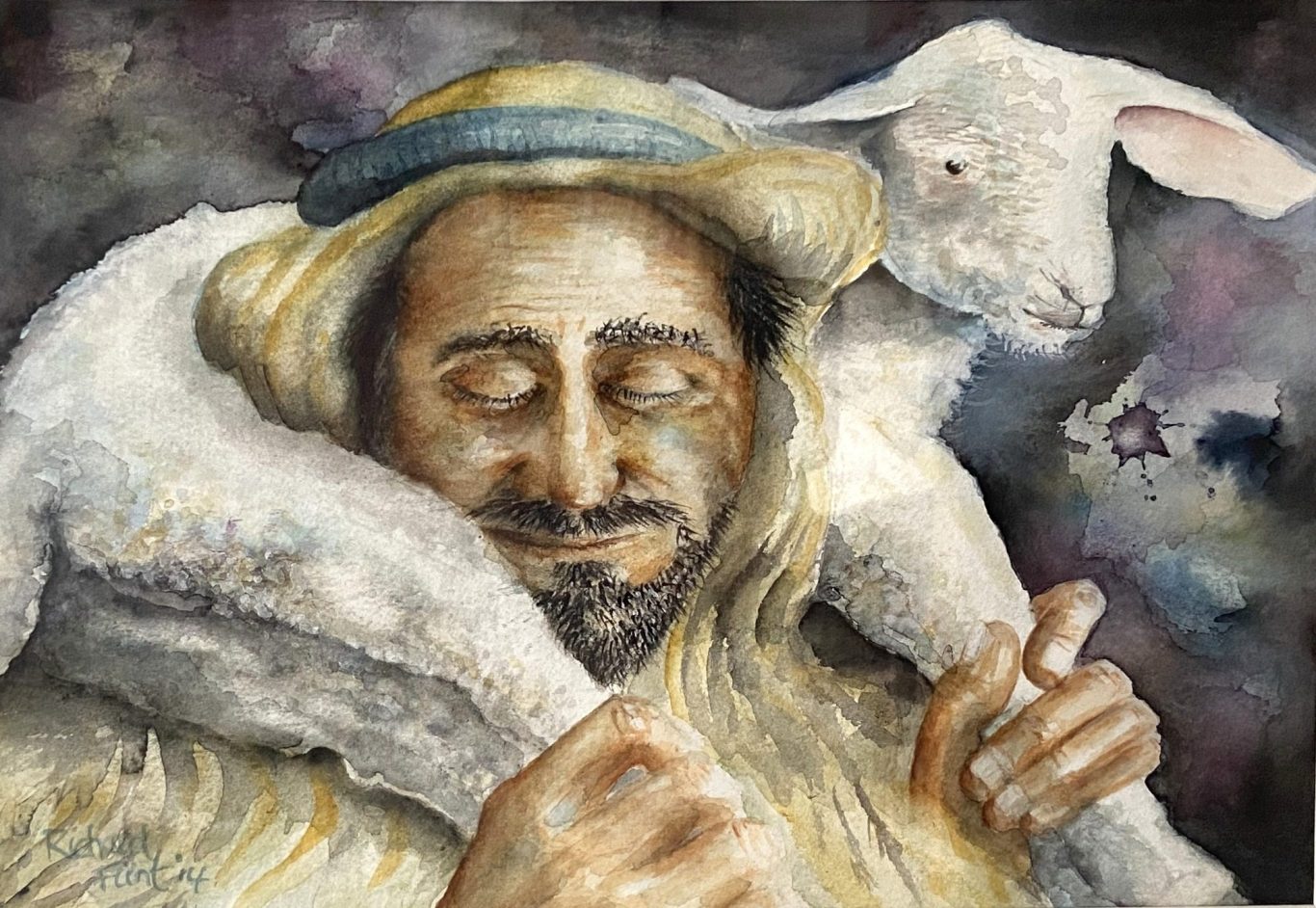
Once upon a time, a man and his wife were walking their dogs one hot Sunday afternoon in spring, along a limestone craggy path that was half way up the hillside. As they turned a corner they became aware of a great commotion below them in a field. What they saw was a field that was full of sheep and these sheep were bleating very loudly as a shepherd and his crew were doing some sort of sheep management thing in the field below. How interesting, the man thought, and he pointed it out to his wife who was more concerned that one of the dogs had disappeared chasing a pheasant.
As they walked on a little further, the man became aware of something else. He could hear another noise. And he said to his distracted wife, 'Stop a moment, what do you hear?'
She said 'the sheep making a racket. why?'
'No listen... can you hear that?'
'Can I hear what?'
'Its coming from over there, in that small wood, there is a still small bleat.'
'A what?'
'its a lamb bleating'
'Oh yeah, you're right' she could hear it as well
' And look, in the corner of the wood. Look where the sound is coming from, can you see?'
'Yeah, there is a speck of white' confirmed the wife.
When the man look back at the field below he saw there was quite a distance between the flock and the lamb. The field was beyond the other side of the wood, about 100 metres away. He then noticed something else, there was a group of sheep, a small part of the flock, that seemed to be facing toward the lamb on the lamb side of the field and it seemed as though they were calling towards the lost lamb. Somehow this lamb had become separated from the rest of the flock and the flock seemed to be aware of this. And now, what the man and his wife were witnessing could only be described as a forlorn and desperate conversation between the flock and the lost lamb in the woods.
They decided that no doubt the shepherd and his crew would themselves become aware of the situation, particularly if they were to count their sheep and that they would continue on their way walking their dogs, especially as the pheasant chaser had returned wagging his tail. They were coming back this way anyway and no doubt on their return things would be sorted.
So the man, his wife and their two dogs continued on their way, around the cliffs to the cafe and then back again. It was now about two hours later as they once again came along the limestone craggy path. And as they rounded the corner, what did they find? Things had quietened down considerably. The shepherd and his crew had gone. There were still a small part of the flock where they had been before and sadly there was still the still small bleat of the lamb in the woods. The mournful conversation between the two could still be heard in the valley.
'What are we going to do?' asked the wife
'I don't know, I am no shepherd and how could I ever get to the lamb. There is no way from here.' the man replied 'And anyway look at me, I have only got one good sandal now that the other one got caught on that rock.'
'So that's that then, you are going to leave that poor little lamb to die. It will soon be dark and then what?' the wife said encouragingly
'Sorry, love, let's be realistic, it's not our responsibility, it is just one of those things. Come on lets get back to the car'
And that is what they did. They returned to their car and began to drive down the twisty twiny road that took them out of the woods, down through the levels and back to their home. However, as they slowed down to go over a railway level crossing, the man notice a track to the right. He realised that this was the track that the shepherds had used in their vehicles. Therefore, this was a way to the field where the flock of sheep were and then, beyond them, it would potentially also be a way to the small wood and the lost lamb. Perhaps he could do something after all?
'Why are we stopping here?' the wife asked as she looked up from her phone for the first time since they had begun driving.
'I have got an idea.' The man pulled the car into a layby, he got out and began to walk back to the track he had seen,
'If I am not back in an hour call the emergency services' he said half jokingly over his shoulder to his wife who had also got out of the car to try and calm the dogs down because they were also confused.
So off he trudged in his one good sandal. A silly joke came to his mind as he made his way down the track towards the sheep fold and the wood beyond, What do you call a French man in sandals? Phillippe Felop he chuckled to himself. He came to the first gate which was chained so he had to clamber over it, on the other side he encountered an angry and very mangy lone sheep. He quickly hopped over the next gate to get out of there and he was then at the sheep fold. He tried to tell the flock what he was up to but they didn't seem to understand, he didn't speak sheep. He assessed the situation and worked out where he had to go to get to the little wood where he hoped he would still find the lost lamb. This involved, why are all the gates locked?, a fair bit gate clambering in his dodgy footwear.
He slowly approached the little wood that had its own wall and he then noticed that there was a style of sorts that provided a way into it. However, on getting closer to the style, what did he find? Huddled up against the wall to the right of the style, there was a dead lamb. Oh, no! He could not believe it. He was too late. As he made to turn back, he heard it. That still small bleat, which from where he was now was not so small. The lamb, the lost lamb, was still in the woods and it was still lost.
Reinvigorated the man stepped carefully up and over the rickety style and as he looked down at the landing zone on the other side of the wall, he was not best pleased. There he was standing on the top of the style, on top of the wall in his broken sandals and in his shorts, below him and filling the space, the two or three metres before he could enter the wood, were a fine collection of stinging nettles and brambles. He realised he was going to have to take his chances and just go for it despite the pain and the potential loss of blood. And this is what he did, ouch! ooh, that hurts! where are the dock leaves when you need them? He made it painfully into the wood with legs and feet stung and scratched. Where was the lamb? It had all gone quiet in the wood. And then he caught some movement out of the corner of his eye. There it was! About ten metres away cowering under a fallen tree, the lamb was looking intently at this intruder in his wood and he did not look impressed.
Slowly the man tried to close the distance between himself and the lamb. However, you will never guess what happened every time he did, the lamb ran away. This cat and mouse game continued for about fifteen minutes, and the lamb was gradually moving towards the far edge of the wood. The man thought he now had a chance and made a desperate move to get to the lamb when all of a sudden, the lamb was gone. The lamb had found a hole in the wall and had escaped out of the wood and was now in a field.
As the man himself emerged out of the wood and surveyed the scene, he realised he had even more of a problem now. The field was on the far side of the wood from the rest of the flock and so the lamb still required catching. But how to catch this not so small lamb now that it had the run of a field and the man was not best shod for the task? At this moment he decided to draw upon his inner shepherd. The lamb was actually not too far away and was looking at the man quizzically, who are you? And what do you think you are doing? If the man had heard the lambs thoughts he would probably have asked the same questions of himself in this moment.
So once again, arms out stretched he shuffled slowly toward the lamb, trying to manoeuvre it into the corner of the field. This worked, the lamb wasn't the brightest and it actually cornered itself. So the situation was now that the lamb was right in the corner of the field and the man with arms out stretched was standing about a metre away. The man made his move and he lunged forward. And the lamb just stood there where he was and allowed the man to grab hold of it. Job done!? Not quite.
The man, now carrying quite a chunky lamb, it was much bigger than the dead lamb he had found earlier, began to assess the situation. The lamb had to be returned to the flock. The field in which the rest of the flock was situated was only accessible from where he was now, without going back through the wood, by skirting all the way around the wood. This would involve crossing two or three fields and solving the problem of how to negotiate a locked gate or three whilst carrying an increasingly heavy lamb in deteriorating footwear. This is what he would have to do. The good news was that the lamb had actually resigned itself to its fate and was not putting up any kind of resistance. In fact, it was kind of nestling in the man's arms, all together now, aarghh!
He actually quite enjoyed carrying the weight of this lamb, and the lamb remained so still in his arms as they made their way across the fields together. The gates were tricky but doable and soon they were approaching the far side of the wood and the sheep field. He actually felt sad to say goodbye to the lamb as he placed it on top of the wall allowing it to jump down to once again join its flock who had come over to seemingly say 'welcome home'. And without a look back the lamb was gone and was now at home and safe. The man then began to trudge back to his waiting wife and dogs with quite a story to tell, the tale of a shepherd for the day.
This is a true story, it is something that occurred a couple of years ago. And as a story it does carry some interesting analogies with regards to the Lord hearing and responding to the cries of the lost. Another shepherd, David, in Psalm 40 captures this wonderful work of seeking and saving the lost,
I waited patiently for the LORD; and he inclined unto me, and heard my cry. He brought me up also out of an horrible pit, out of the miry clay, and set my feet upon a rock, and established my go- ings. And he hath put a new song in my mouth, even praise unto our God: many shall see it, and fear, and shall trust in the LORD. Psalm 40:1-3
The story also reminds us that the Lord has done what he can to reach us. He has found a way. He has come down to find us, when he hears our call. And he will not leave us until we are safely in his arms and he will then carry us home. Indeed,initially this might involve some reluctance before the lost will fall into the Lord's arms. However, the Holy Spirit is very good at manouevring us in to a corner.
The role of the other sheep is also interesting hrer. They played their part by amplifying the call. They helped to get the attention of the man and to support the lamb in the rescue. This speaks to us of the value of prayer and intercession for both the lost from our own flock or natural family and for those who have strayed from our flock or spiritual family.
There is also an element of this story that is also illustrative of the sad fact that at times our earthly shepherds are not quite as attentive as they might be, and too many lambs are going astray. The dead lamb is a scary reminder of the potential consequences when this happens. Like in the parable of the lost sheep in the Bible every single member of the flock is important and our shepherd, Jesus, will do whatever it takes to bring them home.
Perhaps, if this is you today? If you can relate to the lamb lost in your own particular deep dark wood, call out to the shepherd and he will hear you and he will bring you home. Like the psalmist says he will hear your cry.
Having therefore these promises, dearly beloved...
July 26
The scriptural reference in the title of this blog comes from 2 Corinthians 7:1, the whole verse reads as follows,
Having therefore these promises, dearly beloved, let us cleanse ourselves from all filthiness of the flesh and spirit, perfecting holiness in the fear of God.
It seems to me that the scripture editors when adding the verses and chapters to this passage have got it slightly wrong, the promises in question come at the end of the previous chapter. However, as promises go, these go a long way.
...for ye are the temple of the living God; as God hath said, I will dwell in them, and walk in them; and I will be their God, and they shall be my people. 2 Corinthians 6:16b
The Apostle Paul is writing to the dynamic body of believers in Corinth and telling them they are missing out, there is more. I believe this is truly a powerful word for our time! The challenge here is to the first century church at Corinth and specifically to its worldliness, but it also speaks down the centuries to us as well, doesn't it? In the next blog we will be exploring the five ways that this church had blurred the lines that should have marked them out as being a truly authentic fellowship of believers untainted by the world and its ways. In this blog I would like to encourage and excite us in the Lord with regards to the potential we truly have to be the people of God for these, the times in which we are called to follow the Lord. This is our time. And we need to know that there is more! The challenge for us yet again is to respond to this question, are we willing to pay the price. Indeed, a price that will open up for us an opportunity to enjoy these promises and 'the how much more' that Father offers to us. We do need to know that our land, our town and even our street has the potential in Christ to be a land, town or street full of promise, his promise.
Before we explore the promises further, however, I would like to point out that the language that Paul uses here is very Old Testament, I don't mean this in a bad way, I am simply stating the fact that we first read these words in the Old Testament. For the Lord has said as much before, this is because the prophetic word is cyclical, there will be more than one iteration of a particular word over time. Sadly the opportunity was not taken then, will we be ready and able to take it this time, even today?
In Leviticus 26:12 we do read something very similar to what we have read in 2 Corinthians 6,
And I will walk among you, and will be your God, and ye shall be my people.
The Lord goes on to give the context for these promises in the next verse,
I am the LORD your God, which brought you forth out of the land of Egypt, that ye should not be their bondmen; and I . . have broken the bands of your yoke, and made you go upright. Leviticus 26:13
However, there are conditions,
But if ye will not hearken unto me...And if ye shall despise my statutes...or if your soul abhor my judgments... that ye break my covenant Leviticus 26:14a,15a,c
Then, consequences,
I will set my face against you...I will break the pride of your power; and I will make your heaven as iron, and your earth as brass Leviticus 26:17a,19
We will return to these consequences for disobedience later, bet you can't wait for that. There is one other Old Testament scripture that I would like to look at to before we return to the apostle Paul and his teaching in 2 Corinthians 6, and this is in Ezekiel. Here we find the same form of words, this time they come in the form of a wonderful prophecy.
And I will give them one heart, and I will put a new spirit within you; and I will take the stony heart out of their flesh, and will give them an heart of flesh: That they may walk in my statutes, and keep mine ordinances, and do them: and they shall be my people, and I will be their God. Ezekiel 11:19,20
Having previously offered this opportunity to the children of Israel as they made their way to the original land of promises, prophetically it is still being kept open for them and this will find its eventual fulfilment for the Israel of God within the outworking of Father' plans during the Millennial reign of his son, Jesus Christ. The surprising thing is that the apostle Paul, in 2 Corinthians 6, appropriates these particular promises for the Body of Christ two thousand years ago. The reason being can be seen in a subtle change of wording in Paul's version. Indeed, a change that indicates that we, the Body of Christ, even today, have the crucial element that makes these promises possible for us to potentially enjoy. We, through the Holy Spirit, have God on the inside. It is only here that Father states that he dwells in a people, for Israel he walks with them, for us, however, he walks in us! I will dwell in them, and walk in them...
Thereby, in us the expectations from the prophecy in Ezekiel are potentially fulfilled. Expectations that there would be a people who would receive a new spirit within them. However, As I say Father God has not finished with his Israel quite yet.
Indeed, having said all this you might counter, that for us this is already a done deal. He already dwells in us, but the phrase ...and walk in them seems to indicate that Father does want to take this indwelling to a new level for us. What does it mean for God to walk in us? However, before we try and address this question we first need to understand a little more clearly what it means for us be viewed as a living temple by the Lord.
Indeed, what implications does this have for us? Firstly, a temple is a place for sacrifice. For us, in Christ, we have the privilege of being both the place where sacrifices are to be made, but also we are challenged to actually be the sacrifice as well,
I beseech you therefore, brethren, by the mercies of God, that ye present your bodies a living sacrifice, holy, acceptable unto God, which is your reasonable service. Romans 12:1
The type of sacrifice that is being described here by Paul is the whole burnt sacrifice and this sacrifice within the Jewish sacral cult was often described as the one that produced an aroma that was very pleasing to the Lord(see Exodus 29:25 for example). And it was a sacrifice that required everything to be consumed by the flames. Indeed, when we turn to other verses in scripture that identify the Body as a temple both corporately and for us as individuals within it, we will notice that certain strictures like with Israel, do apply to this metaphor.
Firstly in 1 Corinthians 3: 16,17 where we read the following,
Know ye not that ye are the temple of God, and that the Spirit of God dwelleth in you? If any man defile the temple of God, him shall God destroy; for the temple of God is holy, which temple ye are.
Do we know this? Do we know that we are the temple of the living God? How aware are we that we carry the very presence, the Spirit of God (see my blog, 'Carrying the Presence' for more about this). This is scary! Do we know the weight of responsibility that we carry as a temple? Important questions. Pauls says something similar later in his letter, where he again he questions our level of revelation and understanding.
What? know ye not that your body is the temple of the Holy Ghost which is in you, which ye have of God, and ye are not your own? For ye are bought with a price: therefore glorify God in your body, and in your spirit, which are God's. 1 Corinthians 6:19,20
Therefore, this promise, which for us should be a lived reality, has consequences if misappropriated and abused. The conditional 'if' is crucial. Isn't this so similar to what we saw in Leviticus? Do we believe this to be true? Do we believe that there are consequences for getting things wrong?
A second aspect of our life as a living embodiment of a temple is to understand that as such we stand on a daily basis at the interface between God and man. We are not just the building, we are not just the sacrifice, but we are also the priest to our temple. As we have seen in the first point above, we are called to keep and guard the temple of our body, soul and spirit, this is a priestly duty. However, we are also called to serve others who come to us and guide them towards the altar at the heart of our being which is the cross of Christ. That they might offer their own lives there also. There is a powerful picture of this within scripture.
In the book of Numbers we find a group of Israelites rebelling against the leadership of Moses during the Exodus. This event is referenced in the book of Jude as the rebellion of Korah. As the situation develops and the miscreants have been dealt with by being swallowed alive by the earth and taken down to , presumably, hell, there is a secondary issue when others, who have been affected by this saga, also begin to murmur. This causes a plague to sweep through the camp of the children of Israel, until that is, Moses stands in the gap and tells his brother Aaron to run and get fire from the altar. And it is at this point that we read the following,
And he stood between the dead and the living; and the plague was stayed. Numbers 16:48
The fire from the temple was brought bear where it counts between the living and the dead. This is where the Lord desires to place us, do we have any fire from the altar?
As we return to the passage in 2 Corinthians 6 we will see the essential problem that Paul has been addressing in this passage. There are wonderful promises, but there is also a level of conditionality, an 'if'.
Wherefore come out from among them, and be ye separate, saith the Lord, and touch not the unclean thing; and I will re ceive you, And will be a Father unto you, and ye shall be my sons and daughters, saith the Lord Almighty. 2 Corinthians 6: 17
There needs to be a separation. Lines need to be drawn and no longer blurred in our life and in the life of the Body of Christ. Doesn't there? Mixture has always been anathema to the Lord, this is clearly described and proscribed in the Law (Leviticus 19:19). Elsewhere, Paul also challenges mixture in the Body,
That ye may be blameless and harmless, the sons of God, without rebuke, in the midst of a crooked and perverse nation, among whom ye shine as lights in the world Philippians 2:15
The challenge comes through the word translated here as 'harmless', the Greek here actually means to be unmixed. The apostle James is in the same territory when he challenges the 'double minded' amongst us (see James 4:8) to sort their hearts out.
However, if and when we do get it right, the promise is worth it. The phrase is translated 'and I will receive you', but again a little digging reveals that what Paul is actually telling us is that Father will take us by the hand(literal meaning of dechomai) and be a Father to us. He will be truly in us and even walk in us, he will truly be our God and our spiritual father. We will be his sons and daughters, in a way that perhaps we haven't experienced so far. A new way of intimacy in him. A way in which Father God actually walks in us, we have a continual conversation with heaven as described by Paul (Philippians 3:20). For me this is where I enjoy my spiritual language, it enables me to maintain a continual dialogue with the Lord.
For we are his workmanship, created in Christ Jesus unto good works, which God hath before ordained that we should walk in them. Philippians 2:10
Perhaps as we walk in Father's pre-ordained plans, he is walk in us through them?
Having therefore these promises, dearly beloved, let us cleanse ourselves from all filthiness of the flesh and spirit, perfecting holiness in the fear of God.
Therefore, for us to fully and to truly enjoy such promises the ball, as they say, is in our court. We are being challenged here to come out of the world, to separate our selves from any worldly influence that we might be mixed up in and be unmixed, and to become fully the Lord's own. Indeed, going nowhere near anything that has been tainted by the world. And moreover, to actively apply the cross to all thjs stuff and to thereby cleanse ourselves from any such filthiness of both the flesh and the spirit. Dirty flesh we can understand ,but filthiness of the spirit? Could we be in Charismania territory here, read my story I have been there and it it is not clean, your spirit is smeared by this distorted spirituality.
And the grace of of the Lord is there waiting for us, as is the waiting Father. In whatever way we might be prodigal the call is to come home and let Father put it right and put us back on the way to perfecting holiness in the new found fear of God.
To finish, as promised, what about the consequences for disobedience that are described in Leviticus that we note above,
....and I will make your heaven as iron, and your earth as brass Leviticus 26:19b
Don't things feel a bit like this at the moment, I wonder why?
Every Place on which Your Soul shall Tread...I will Give it to You
June 26

As the children of Israel cross over the Jordan and enter the land of promise they have these words ringing in their hearts,
Every place that the sole of your foot shall tread upon, that have I given unto you, as I said unto Moses. Joshua 1:3
As I read these words recently I had a question. How do I apply this verse and the message of territorial overcoming to my own life and walk with the Lord? I am not content with a particular mis-application of this verse to support the 'Kingdom Now' idea that we, as the church, have an end time world domination mandate given to us from on high. In John 18:36 Jesus clearly tells us that his kingdom is not of this world. Therefore, what, if anything, is the challenge of this verse for us today?
Perhaps we might find an answer in the writing of the same author, the apostle John? What does he say in 1 John 5:4,
For whatsoever is born of God overcometh the world: and this is the victory that overcometh the world, even our faith.
John is challenging everyone who is born of God, that hopefully includes you and me, to overcome the world. If you are wearing Nike trainers the good news is that you are already walking this talk, because nike is the Greek word for victory and overcoming. You have ticked that box-geddit? Sorry. What does it mean for you and me to overcome the world? Does it mean that we, as part of the church, take over the running of the world and its institutions? Or, is there something else at play here?
When I read this verse in 1 John 5 I am reminded of another Johannine passage, the introduction to his Gospel where we read the following,
But as many as received him, to them gave he power to become the sons of God, even to them that believe on his name: Which were born, not of blood, nor of the will of the flesh, nor of the will of man, but of God. John 1:12,13
Notice what is said here, we who have been born of God, that's you and me again, have been given power to become the sons of God. I believe that this takes us beyond the wonderful moment of new birth at the cross to the ongoing journey to becomie true mature followers of Jesus. The Greek word that is translated 'power' in this verse is not the usual word 'dynamis' from which we get our word dynamite, Here the Greek word is 'exousia' which carries a meaning of executive power, the authority and wherewithal to make this thing happen. Therefore with reference to the verse we are considering and the idea within it of overcoming the world we are being informed here in this verse that we have what we need to overcome the world. We are potentially fully equipped for this task. But what is this task? What does it mean for little old, less of the old please, you and me to overcome the world? After all, and in John again, Jesus tells us that he has already overcome the world (John 16:33), so what is there left for us to do?
John to the rescue, let us turn back to his first letter and the passage in chapter 5 that we have already visited. There does seem to be a qualification here. The verse we have already explored tells us that this overcoming is in the faith realm, it is therefore a spiritual overcoming since faith is the language of the spirit. This is confirmed in the next verse where John asks a similar question to the one we are asking,
Who is he that overcometh the world, but he that believeth that Jesus is the Son of God? John 5:5S
So, our overcoming is tied to our belief or faith that Jesus is the Son of God. If we now turn to the preceding verses in this chapter we will be shown the one important element, beyond our faith, that is significant for our overcoming agenda in Christ. Let us take these verse by verse and forgive me I am making an executive decision here. I will be using, a pause to prepare yourself, the New Living Translation for this, another pause for the gasp. It is just that it expresses things a little more clearly and it does not here mislead us in any way, so there its my decision and Iam sticking to it.
Everyone who believes that Jesus is the Christ has become a child of God. And everyone who loves the Father loves his children, too. John 5:1
Therefore, belief or faith through revelation that Jesus is our messiah is formative for us to become a child of God. And at the heart of this becoming is a developing love for Father that is expressed in the love of our brothers and sisters. It is all about relationship. We desperately try and turn this beautiful faith into a religion, when all it really wants is a bit of love. This clearly, if you are anything like me and you probably are, is more easily said than done. The sad truth about the human condition is that we find it easier to hate than to love. Love does not come naturally, particularly in church life, as I pull out another arrow. There is potentially then a link between this crazy little thing called love and overcoming the world. Moving on...
We know we love God’s children if we love God and obey his commandments. . Loving God means keeping his commandments, and his commandments are not burdensome. John 5:2,3
Do you know what, I am going to simplify this scripture even further and boil it down to one simple statement.
A true child of God walks each day in loving obedience. (otherwise known as a relationship)
And moreover, if done right, this walk of loving obedience, will in turn enable us to be able to love, as is expressed above in verse 1, Father's other kids. Here is the challenge. Isn't it? This is where the overcoming comes in. What is it that gets in the way of us being able to love others? Once again, perhaps the apostle John has something to say here? What does 1 John 2:15,16 tell us (back to the KJV-phew)?
Love not the world, neither the things that are in the world. If any man love the world, the love of the Father is not in him. For all that is in the world, the lust of the flesh, and the lust of the eyes, and the pride of life, is not of the Father, but is of the world.
We are called to walk in loving obedience with the Father and ta-dah ...this is the victory that overcometh the world, even our faith. And it is a walk of overcoming where we apply the finished work of Christ on the cross to our recalcitrant hearts. It is his victory applied in our lives, alleluia! In short we need to overcome the world in us, the selfish world of lust and pride so that we are able to truly able to love others. There is trite saying that has done the rounds in church world of late which says that 'you can not love others if you don't love yourself'. Is this true? If loving yourself means your focus is on pleasing yourself, how can you then have the capacity to love and please others? I am not saying that you have to hate yourself, however, perhaps to not take ourselves quite so seriously. I think that is called meekness.
The apostle Paul puts it this way,
For if ye live after the flesh, ye shall die: but if ye through the Spirit do mortify the deeds of the body, ye shall live For as many as are led by the Spirit of God, they are the sons of God. Romans 8:13,14
We are back in John 1 territory here. The power, our power, to become a son of God is powered by a person who is the, appropriately named, Holy Spirit. And it is he who will be taking us by the hand and leading us down the path of overcoming, And here we return, at last to the title of this blog. For as we set off each day to follow the Lord, led of the Holy Spirit into the things that Father has planned in advance for us to walk in and through, to overcome, he has somthing to say to you today. His word to you is this , as you walk in obedience and out of love every place that your soul shall tread upon in faith shall be given to you-you will be more than an overcomer in this area of your soul life. There will be a moment of break through in Christ, and you know you will not be going that way again. It is done, finished. You are NOT that person anymore. And know that every temptation is an opportunity to be an overcomer. And know that you are not a victim but an overcomer, because today Father's grace is sufficient and he that has begun a good work in you WILL complete it.
And the very God of peace sanctify you wholly; and I pray God your whole spirit and soul and body be preserved blameless unto the coming of our Lord Jesus Christ
Faithful is he that calleth you, who also will do it 1Thessalonians 5:23,24
Amen
Who is a Wise Man... Among You?
June 26
Who are the wise men or women that walk among us in the body of Christ? Have a look around, who would you choose? Are there particular founts of wisdom that we might turn to online, perhaps in YouTube podcast 'heaven'. I have recently found 'Socrates in the City' which endeavours to put before us and the world the interesting Christian thinkers of our day, wise old individuals such as Professor John C. Lennox. It is all very interesting and wise, I suppose, in a certain way of understanding the term, but... I am not sure this is what the particular question from the pen of James is really talking about here.
Having recently read James' letter, I was struck by the fact that in the first chapter having begun by jumping straight into encouraging the Hebrew believers to whom he is writing, a cohort of the first century body that was spread throughout modern day Türkiye, providing them with a perspective on the difficulties they seem to have been having following the Lord. 'Count it all joy' he says when the tempter is at the door of their hearts. He encourages them to understand the process. To recognise what Father is actually doing and why they are being taken through the things that they are being taken through. For James it is all about the perfect work of Father God, a perfect work leading them to a state of spirituality whereby they 'may be perfect and entire, wanting for nothing.' Therefore, he is telling them, man( and woman) up, take it on the chin and enjoy the ride!
So, why does James then immediately start talking about wisdom. We have all heard sermons where this verse, and the verses that follow it, are used to encourage us to ask Father for wisdom to choose the right spouse, car or Lear jet. However, I have always thought that this is a bit strange and a bit incongruous, i.e. a little bit out of context, is this really is what James intended? Surely, James is not changing the subject here. Surely there must be a way of understanding the use of the term wisdom within the process of heart sanctification which does seem to be area that is being addressed by James in this part of his letter.
To help us the context is important here as it always is in rightly dividing scripture, all together now 'a text out of context is a pretext'. What is also important here is consistency. For any author the use of a key term will have the same meaning when ever and where ever he uses it. So before we return to this verse and sort out what the author is really saying here beyond the choice between Rolex or Timex. Let us turn to chapter 3 of the letter and specifically to the passage beginning at verse 13. And here we have the very question that we started with,
Who is a wise man and endued with knowledge among you?
And what is his answer to this question?
...let him shew out of a good conversation his works with meekness of wisdom.
What is he telling us here? Wisdom is not about choice making, no, wisdom is a state of being. Wisdom is a quality of life that underpins who we are in Christ and which is borne out by the fruit that we bear. We are wise when the things we say match the things we do, in a good way. We are wise when we walk in integrity.
James goes on (vv 17,18),
But the wisdom that is from above is first pure, then peaceable, gentle, and easy to be intreated, full of mercy and good fruits, without partiality, and without hypocrisy. And the fruit of righteousness is sown in peace of them that make peace.
This is the Sermon on the Mount lifestyle writ large here (isn't it Maurice!?) and our goal is therefore as followers of Christ is this true wisdom that comes out of heaven and the heart of father for each one of us, if only we would realise it! And moreover to then as a result walk after the Lord as his spiritual peacemakers.
James by using the term wisdom in this way is showing us his Hebrew roots. This is the language of Proverbs.
Wisdom is the principal thing; therefore get wisdom: and with all thy getting get understanding. Exalt her, and she shall promote thee: she shall bring thee to honour, when thou dost embrace her. She shall give to thine head an ornament of grace: a crown of glory shall she deliver to thee. Proverbs 4:7-9
Like in the early chapters of the book of Proverbs we are each invited to come to Jesus and to learn from him, and to take on his yoke which is true wisdom. This is the wonderful wisdom from above that James describes so beautifully as pure, peaceable, gentle... This is the choice that lies before us. When we are tempted, when the unmentionable is hitting the fan, when our poor little self life with all its needy pride and ambition is not getting what it wants.... this is the choice.
If any of you lack wisdom, let him ask of God, that giveth to all men liberally, and upbraideth not; and it shall be given him. James 1:6
However, if you do reach out to Father, be careful he is not fooled, really mean it, no game playing here please this is too important,
Let him ask in faith, nothing wavering. For he that wavereth is like a wave of the sea driven with the wind and tossed. James 1:7
Sadly, Father knows only too well that the opposite of faith is,
A double minded man (who) is unstable in all his ways. James 1:9
For whom, however, the good news is that there is a way back,
But he giveth more grace. Wherefore he saith, God resisteth the proud, but giveth grace unto the humble. Submit yourselves therefore to God. Resist the devil, and he will flee from you. Draw nigh to God, and he will draw nigh to you. Cleanse your hands, ye sinners; and purify your hearts, ye double minded. Be afflicted, and mourn, and weep: let your laughter be turned to mourning, and your joy to heaviness. Humble yourselves in the sight of the Lord, and he shall lift you up. James 4:6-10
In Christ there is a reboot available and the waiting Father is always waiting, waiting to truly welcome us home and to help us understand how to be wise.
That your faith should not stand in the wisdom of men, but in the power of God. Howbeit we speak wisdom among them that are perfect: yet not the wisdom of this world, nor of the princes of this world, that come to nought: But we speak the wisdom of God in a mystery, even the hidden wisdom, which God ordained before the world unto our glory ... 1 Corinthians 2:5-7
And the Wilderness Shall be Glad for Them!
June 26
The Lord in his wonderful grace and mercy is doing some interesting things in my life at the moment. The other day I asked him if he would give me an overarching perspective on what he is up to- and I did say please. And a little while later I was also able to say 'thank you'. So I thought that I would share this with you, if that is ok?
Having asked this question, in my spirit, I felt led to a scripture that I suddenly realised, having turned to it, that was actually oh so familiar, but now it came alive in a way that I would not have been able to have appreciated in the past. I was now in the wilderness, and I have been in a relatively solitary place over the last few years, this scripture now spoke to me and to what the Lord is doing in a way it had never done before. Let us turn, therefore, in the word to Isaiah 35.
The wilderness and the solitary place shall be glad for them; and the desert shall rejoice, and blossom as the rose. It shall blossom abundantly, and rejoice even with joy and singing: the glory of Lebanon shall be given unto it, the excel lency of Carmel and Sharon, they shall see the glory of the LORD, and the excellency of our God. Isaiah 35:1-3
As I have said above, and as you can read all about in My Journey of faith in the About Me section of this website, the walk of late has been a dusty but fruitful one. My sandals haven't worn out and I was always well fed and watered along the way, praise the Lord! However, it seems as though times they are a changing as Mr. Dylan has been known to sing. Gatherings are happening. We now meet once a month in Manchester and we have also begun to meet more locally every fortnight. And both meetings carry the same focus to simply meet with each other and to meet with the Lord, his word and in his Spirit. Indeed, it is for this that I was asking the Lord for his perspective.
Please, don't misunderstand me, I remain in the wilderness and will do until the times comes for me to cross over into the promised land of the Lord's eternal purposes for me, which will hopefully be as part of the bride and to enjoy and be part of the Millennial reign of Christ. However, hopefully now I can enjoy the journey with others in a way that I haven't experienced heretofore.
So that said, what is the perspective that the Lord would give us at this time?
Essentially, through this scripture, what I believe the Lord would say to us, the wilderness is now a place of blessing for those who have responded to the call to walk this way. And moreover, the solitary will now be able to find a spiritual home and true fellowship. And the sand dunes of our world will reverberate to the sound of rejoicing. As the prophet says elsewhere, the desert shall become a watered garden (check out Isaiah 58 this is also an important scripture for us). And like Adam before us we are called to keep and guard it (see Genesis 3)!
This morning the Lord developed my understanding of this further by showing me that within the writing of the apostle Paul it is possible to often see a midrash or commentary of Old Testament scriptuure, and today I saw this with regards the first part of Isaiah 35 and this can be found in his letter to the church in Ephesus. Let me take us through it. Isaiah writes in verse 2b and 3a of chapter 35,
...the excellency of Carmel and Sharon, they shall see the glory of the LORD, and the excellency of our God. Strengthen ye the weak hands, and confirm the feeble knees
Leaving aside the reference to Carmel and Sharon until a bit later (we have more to say here). Lets us focus on some key phrases and words that are found here in Isaiah 35, such as the glory of the Lord and the call be strengthened. What do we read in Ephesians 3:16,
That he would grant you, according to the riches of his glory, to be strengthened with might by his Spirit in the inner man
You see, the same ideas being expressed within the new context of the new covenant. What will happen in the wilderness is that through the riches of his glory, and the excellency of our God, we will be strengthened where it counts, in the inner man by his Spirit, which is his presence that we carry.
Again, we read in Isaiah 35,
Say to them that are of a fearful heart, Be strong, fear not...
And what do we read in Ephesians 3:17?
That Christ may dwell in your hearts by faith; that ye, being rooted and grounded in love
In the wilderness, our hearts by faith are indwelt by Christ, who establishes there a firm foundation of love. Notice that we don't just have a foundation of stone by which we are grounded in and by his love, but we also have deep roots that tap right down into the heart of Father. Therefore, no matter how dry or hot it is, our leaves won't fade and the fruit will carry on coming (See Psalm 1 and Jeremiah 17:8). Alleluia!
Finally, Isaiah 35:5 declares,
Then the eyes of the blind shall be opened, and the ears of the deaf shall be unstopped.
From the pen of Paul we read thw following,
May be able to comprehend with all saints what is the breadth, and length, and depth, and height; And to know the love of Christ, which passeth knowledge, that ye might be filled with all the fulness of God. Ephesians 3:18,19
What is another way to say that we comprehend something, it is to have our spiritual eyes and ears opened. This is what the Lord has for us in the wilderness. It will be a place of end of end times revelation concerning the truth (yes, there is such a thing) and concerning the times in which we are living. There will be a voice in the wilderness, a John the baptist generation, preparing the way for the return of the Lord for ourselves and for anyone else who would listen. Amen.
Isaiah continues to lay out certain important aspects of what this new reality will look like.
Then shall the lame man leap as an hart, and the tongue of the dumb sing: for in the wilderness shall waters break out, and streams in the desert. And the parched ground shall become a pool, and the thirsty land springs of water... Isaiah 35:6,7a
In the wilderness the lame or those who struggle to walk will find their dancing shoes, the spiritually lame will discover how to walk and to follow, perhaps for the first time in their 'churchianity' dominated lives, Jesus.
In the wilderness the people of God might find their voice and to communicate the true gospel rather than the watered down version that passes for preaching in these days.
In the wilderness the water of the word will flow creating streams and pools in the desert, the thirsty for the true word will have their thirst quenched.
And an highway shall be there, and a way, and it shall be called The way of holiness; the unclean shall not pass over it; but it shall be for those: the wayfaring men, though fools, shall not err therein. No lion shall be there, nor any ravenous beast shall go up thereon, it shall not be found there; but the redeemed shall walk there. Isaiah 35:8,9
In the wilderness there will be a way, the way of holiness. Father will have his way with us, we will rediscover the closet and the walk of discipline such that we can look forward to this yielding the peaceable fruit of righteousness and that we might be partakers of his (the Father's) holiness. The author of Hebrews, remarkably actually continues in chapter 12 of his letter to quote this very scripture.
Wherefore lift up the hands which hang down, and the feeble knees; And make straight paths for your feet, lest that which is lame be turned out of the way; but let it rather be healed. 1 Hebrews 12:12,13
He also suggests that this reality will occur outside of the camp, i.e.in the wilderness,
Wherefore Jesus also, that he might sanctify the people with his own blood, suffered without the gate. Let us go forth therefore unto him without the camp, bearing his reproach. Hebrews 13:12,13
In returning to Isaiah 35 it is also important to notice the kind of individual who will be walking along this way,
the unclean shall not pass over it; but it shall be for those: the wayfaring men, though fools, shall not err therein. ...but the redeemed shall walk there Isaiah 35:8b,9b
This is a way for the spiritually clean, the foolish wayfaring man and the redeemed. The word 'wayfaring' that is used here is a translation of two Hebrew words that are combined to give us this term in English. The Hebrew simply means a person who walks the way, enough said. And the good news is, we don't need to be clever, just redeemed!
In the wilderness this will be the narrow way that will take us home, to Zion! With everlasting joy upon our heads, Alleluia.
If we could briefly return to the two places named in Isaiah 35: 2 Carmel and Sharon. Understanding a little more about these two scriptural locations does feed into the ideas we have been exploring above. Taking Sharon first, for some Sharon will always be the blond barmaid in Eastenders*, for others it will be the dynamic Mancunian church that was lead by William Barratt, Maurice's dad, in the 1960s where they even saw the dead raised and for us today it is a place in ancient Israel that is described as ,
And Sharon shall be a fold of flocks, and the valley of Achor a place for the herds to lie down in, for my people that have sought me. Isaiah 65:10
In the wilderness we will find again a fold for the sheep of the Good Shepherd, a safe place for his flock to lie down. And what do we learn here, such a fold is explicitly described as being for those who are actively seeking the Lord in these days. For me the significance goes even further because this is part of a passage where the prophet also says the following prescient words,
Thus saith the LORD, As the new wine is found in the cluster, and one saith, Destroy it not; for a blessing is in it: so will I do for my servants' sakes, that I may not destroy them all. Isaiah 65:8
In the wilderness the new wine of the Lord will be found in clusters upon his vine.
What about Carmel? We know very well the exploits that the prophet Elijah achieved on mount Carmel, for us, however, I believe the significance lies in the word Carmel itself. For the word literally means a fruitful garden, And in the wilderness gardens will become fruitful. In my latest book, And We Shall also Bear the Heavenly (available to download free as an Epub or PDF document from the My Writings section of this website) at one point I take the reader through the beatitudes as a gardening exercise. The Lord showed me that as he put the first man in a garden, he has now put, as his followers, the garden in us . The garden is our heart and the Father is our gardener preparing our hearts to bear fruit.
Therefore, to conclude, in the wilderness we are being gathered together to support one another to blossom, bear fruit and to enjoy the true blessing of the Lord in these days. This gathering will be outside the camp of the established church, but also relationally connected to it as it is with one of the meetings now on my journey. It will be a safe refuge for all those who would want to come in from the cold and to be once again part of the wider body of Christ. The way he has done it we me is a wonderful story of grace and hearing Father's gentle persuasion.
In short, this is the preparation of the bride, who is being made ready for the return of the bridegroom. This is what the Lord is doing in answer to my initial question, after all isn't it what he has always been doing?
*Eastenders is a long running British soap opera on the BBC, sorry. I know, who cares?
That my joy might remain in you,
and that your joy might be full!
June 26
Joy is a tricky customer. What is joy? As you read this are you joyful? If not, why not? See me after class! I am by nature a glass half empty sort of person and few would describe me as often over flowing with joy, not least my wife. So am I missing out or missing it? The tendency is to view joy in a particular way. Joy is seen generally as a positive emotional state that involves a lot of smiling and an outward exuding of happiness. Here's the thing, I am not sure that this is joy. This said it clearly may be, as an individual who is demonstrating such behaviour may be drawing on a deep sense of inner well being, but not always. Often this type of 'joyful' behaviour is driven in the here and now by some positive moment of happenstance; this where the word happy comes from I believe. Something good happens and as a result we temporarily feel good. Is this joy?
I believe joy is different. I believe joy, as alluded to above, comes from a deep sense of well being within us, why? because joy is spiritual. Afterall, it is one of the fruit of the Holy Spirit that we find listed in Galatians. And as such perhaps this joy should always be with us and available to us. Acting as a positive underpinning to our lives in Christ. The apostle Paul exhorts us to rejoice or to be in 'joy' always and not satisfied with saying this once he says again, rejoice emphasising to the believers in Philippi that this more than feelings it is more like a way of life. To be constantly in joy mode. This seems to suggest that this joy, that is described here as rejoicing, is not reserved only for the good things and the obstensively positive times. Afterall, all things, good and bad, work together for good for those who are called according to his purposes (Romans 8:28), don't they? Are you sure? In order that we can understand what Paul is saying here we need to move on to the next verse,
For whom he did foreknow, he also did predestinate to be conformed to the image of his Son, that he might be the firstborn among many brethren
We are able to rejoice and to find joy in all situations, both good and bad, because all situations are potentially good in Christ. And like in the original creation narrative, the 'good' comes from Father's perspective. When he looks at the new creation being created in our heart he will say that what he sees is good. What he calls good is good, because don't we know that all things work out for good, for whom? For those who are called according to whether that thing makes them feel happy, makes them smile and makes them feel good about themselves and their life? Is that what it says, no. What it does say is that this journey in Christ is all about Father's purposes for us. And what are they? ASs we have read above, to be conformed to the image of Jesus, his son.
When he looks at the new creation being created in our heart he will say that when he sees his son Jesus then it is good.
And this means if we would only realise this then we can and will find this joy and be able to rejoice no matter how hard the moment, or how sweet.
The writer to the Hebrews says exactly the same thing. In chapter 12 we read that there is a great crowd watching us run the race of life in Christ. We are challenged to lose weight, if only. The weight and drag of the world of sin that we carry, the left overs from the lives we have lived in the world. Jesus, who is writing our story, stands at the finishing line encouraging us forward. 'Just look at me , keep your eyes on me, come on keep your focus, you will get here, you will finish your race. Keep your focus on me and you will be unstoppable!'
'Afterall, I have gone before you. I have done the hard part, I went to the cross for the joy that I can stand here now and bring you home.'
The writer goes on to encourage us to not lose heart, not to faint and not to become weary. Why are the believers here losing their heart, faint and becoming worn out? Seemingly because they have lost the plot. This is largely through their not understanding the what and why of what they are going through. Today is the same, the problem is we are not taught this stuff! Just as Jesus was sustained by the deep joy he had in order that he was able to obediently endure what ever Father asked of him, same with us. There is an enduring for each of us, there is a race for each of us. For each of us to arrive at the finishing line we don't, as is widely taught today, need to endure the buffeting of the enemy as a victim. NO, we need to understand that we are being trained, chastised, pushed and prodded in our self life, at times yes Father will even utilise the enemy in this process, to become overcomers, more than conquerors and ultimately conformed to the image of Jesus, who beckons us forward in love.
This is our joy! To know that Father loves us too much to let us stay the same!
Now, in this context and with this understanding, let us read these verses from the letter to the Hebrews,
If ye endure chastening, God dealeth with you as with sons; for what son is he whom the father chasteneth not? But if ye be without chastisement, whereof all are partakers, then are ye bastards, and not sons. Furthermore we have had fathers of our flesh which corrected us, and we gave them reverence: shall we not much rather be in subjection unto the Father of spirits, and live? For they verily for a few days chastened us after their own pleasure; but he for our profit, that we might be partakers of his holiness.
Now no chastening for the present seemeth to be joyous, but grievous: nevertheless afterward it yiel deth the peaceable fruit of righteousness unto them which are exercised thereby.
If we were able to truly understand this for ourselves and as the writer himself qualifies what he is saying and identifies his audience with the chilling phrase, unto them which are exercised thereby. To many of us aren't exercised by this today, because we do not realise that this is path that we need to tread if we truly want to become a mature child of God. And if we did then we would be able to draw on something within us that is not ephemeral, here today and gone tomorrow, and moreover, something that is part of who we are in Christ. Why, because the Lord, if only we would realise it, has invested his joy in our hearts. It is part of our abiding in him.
I saw this today when reading in John 15. Again let us spend some more time in scripture,
If ye abide in me, and my words abide in you, ye shall ask what ye will, and it shall be done unto you.
Jesus is moving his teaching on. Having stated earlier that to abide in him would also result in him, Jesus, abiding in us, the situation is clarified here. The aspect of the son of God that will be abiding in us will be his active word, afterall he is the Word. We are not talking theology here, this is all about the living dynamic of his word at work on our hearts, such that, as we have already seen in Hebrews, we might bear the peaceable fruit of righteousness. This is the context for the quality of question that will receive an affirmative response from Father.
Herein is my Father glorified, that ye bear much fruit; so shall ye be my disciples.
It is through our fruitfulness that the Father is glorified, and this quality of fruitfulness is the very essence of our discipleship.
As the Father hath loved me, so have I loved you: continue ye in my love. If ye keep my commandments, ye shall abide in my love; even as I have kept my Father's commandments, and abide in his love.
This is the fruit of the agape love that is flowing within this wonderful outworking of our relationship in Christ with Father in the Holy Spirit.
These things have I spoken unto you, that my joy might remain in you, and that your joy might be full.
And here we are, underpinning all of this is a deep seated investment of joy, and, look again, it is Jesus' joy that abides in our hearts topping up our own joy to produce a fullness of the stuff. How incredible is that? This is why the apostle James can say the following,
My brethren, count it all joy when ye fall into divers temptations; Knowing this, that the trying of your faith worketh patience. But let patience have her perfect work, that ye may be perfect and entire, wanting nothing. James 1:2-4
And Paul can say this,
For the kingdom of God is not meat and drink; but righteousness, and peace, and joy in the Holy Ghost. For he that in these things serveth Christ is acceptable to God, and approved of men. Romans 14:17,18
Amen
Today is the day we are crossing over!
June 26
The phrase above comes from Moses at the beginning of Deuteronomy 9 as he prepares the children of Israel for the culmination of their flight from Egypt and the 40 year God led meanderings through the wilderness. They were going to cross over the river Jordan that day and this leader, who would not be joining them, was making sure that they understood where they were spiritually and what was expected of them by the Lord God. The most important question he had for them was , are you ready?
The apostle Paul tells us that this very story, the story of the Exodus, was one in which we, with eyes opened by the Holy Spirit and hearts opened by Father, do need to see ourselves and recognise aspects of our own journey in Christ in the highs and lows of the experience of the children of Israel in the wilderness.
Now all these things happened unto them for ensamples: and they are written for our admonition, upon whom the ends of 0 the world are come. 1 Corinthians 10:11
As I was reading in Deuteronomy this morning I believe that I noticed some interesting things by which, if understood and applied, we might be challenged. I could make the obvious connection and ask, if the Lord was to return today would we be ready? There is something of this in what I saw, but I believe there is something a little more subtle that we might need to be cognisant of as we endeavour to follow Jesus in these end of end times.
Moses, having stated that that day was the day of the crossing over, he goes on to reassure them that the Lord God would ensure that their take over of the land and the overcoming of all the mighty nations that would await them on the other side of the Jordan, not forgetting the giants, would be successful. He would be their consuming fire. However, Moses then goes on to remind them how badly they had messed up, the golden calf for example. In fact it got so bad, he says, that the Lord God told Moses that he had had enough of their whingeing, moaning and missing Egypt that he wanted to destroy the whole lot of them and to start again. He did not want you, any of you, to cross over not today not ever. So we may want to ask how they actually got here, skimming stones on the surface of the Jordan? How this motley crew now had a wonderful opportunity to cross over this river and to finally enter the promised land? The key lies in the way Moses had responded to their plight. he had eaten dust for them before the Lord for 40 days-some response!
Thus I fell down before the LORD forty days and forty nights, as I fell down at the first; because the LORD had said he would destroy you. I prayed therefore unto the LORD, and said, O Lord GOD, destroy not thy people and thine inheritance...Deuteronomy 9:25,26a
Moses' intercession is very informative. He reminds the Lord God that, basically, this whole venture was his wonderful plan, indeed a plan that demonstrated his might and his mercy. That it was the outworking of and a fulfilment of the Abrahamic covenant, you do remember that Lord don't you? However, if you follow through with your threat to destroy this people, your people, you do know that it would look bad for you. It will look as you were not able to keep your promise and your covenant. This is not a good look for God. How did Moses get away with this, who can talk to God like this? And moreover, he did not only get away with this-it works,
And I stayed in the mount, according to the first time, forty days and forty nights; and the LORD hearkened unto me at time also, and the LORD would not destroy thee, and the LORD said unto me, Arise, take thy journey before the people, that they may goin and possess the land, which I sware unto their fathers to give unto them. Deuteronomy 10:10,11
The tablets are rewritten by the finger of God, and now they have their own purpose built container, the Ark of the covenant, and at this time it seems as though the covenant is reset, and the people have another chance to prepare themselves and to make themselves ready for crossing over.
I do have a question, in fact a few. Why does this work? How had Moses changed the Lord God's mind? And is there a challenge that tumbles down to us sitting here 2 or 3 thousand years later?
We are told here that crucially the LORD hearkened unto Moses. The Lord heard Moses and the Lord responded to what he heard Moses say, Why? Why does Moses have the ear of the Lord God? Is there anything that we can identify that marks this man out? What has Moses got that makes a difference here?
To understand this and to find the answer to these questions we need to turn to a passage of scripture in Numbers 12. It is here that we will find the key to Moses' capacity to turn the head of the Lord God to look and move in another direction.
For whatever reason, it might have even been love, we are told that Moses had married not just out of his tribe, but outside of his nation and people. He had married an Ethiopian woman, goodness knows where they had met, online? Anyway, Moses' siblings, Aaron and Miriam were not impressed and decided to have words. However, the words that they decided to have were not about the marriage per se, however, this apparent misstep by their brother had prompted them to ask a more profound question, why is Moses the only person that the Lord God is conversational with? And motivated by the thought that their brother was losing the plot as evidenced by the dodgy marriage, they believe that they should also be on one to one terms with the Almighty.
We are told, scarily, And the LORD heard it. Aaron and Miriam did, finally, have the ear of the Lord God but not in a good way. He called them all to meet with him in the tabernacle of the congregation in the cloud. Not before we are told, in parenthesis, what the difference was between them and their brother. The crucial element in this tale that meant Moses was given the wonderful honour of his intimate communion with Lord God, such that at times Moses was even able to change the mind of the creator of the universe,
(Now the man Moses was very meek, above all the men which were upon the face of the earth.) Numbers 12:3
This seems to be telling us that the level of communion we have with the Lord, particularly in terms of standing in the gap for others and having the ear of God, is dependent upon the quality of the person and the quality of the walk that that person has. Such that even when they seem to go awry lifestyle wise as Moses might have done here- the relationship remains. God always looks at the heart! The Lord God describes his relationship with Moses in the following terms in this passage,
With him will I speak mouth to mouth, even apparently, and not in dark speeches; and the similitude of the LORD shall he behold... Numbers 12:8
Elsewhere, Moses is described similarly as speaking to the Lord face to face as a man speaketh to his friend (Exodus 33:11). How are we to understand this for ourselves and then how do we need to respond . Does this speak to us, particularly as we consider our own time and the days we are living through? Moses here stands in the gap for his literal brother and sister in this passage. They judged him, but he does not judge them. And when Miriam became leprous, he did not say serves her right, she clearly had that coming. He did not gloat at their plight in ugly self righteousness. No, he is meek and therefore he stood in the gap and in response to a plea from his brother Aaron Moses beseeched the Lord God to heal Miriam his sister, which the Lord God duly did.
So Moses is shown to intercede for both his own family and the family of his nation, such that come the day when they were to cross over they ready and waiting. What about us? What about our brothers and sisters in the Lord? If this were the day for crossing over, if this was the day for the Lord's return, would they/we be ready? Or are they/we still in so many and various ways like the children of Israel a stiffnecked people wandering in our own self made desert? Do they/we need a covenantal reset, do they/we need others to stand in the gap for them? Indeed, others who have the ear of the Lord, people who the Lord listens to such that his head might be turned and his mind changed|? When we look at scripture and identify the individuals, particularly, within the Old Testament, who had the ear of the Lord God, Noah who was perfect in his generation, Abraham who walked before the Lord God in perfection and no one was on a par with Daniel according to King Nebuchadnezzar, it was and I believe still is all about the quality of the person and the quality of their relationship with the Lord God. But what about us? Spend time in this passage and let it minister to your heart. Notice that it culminates in a call to stand in the gap for our brothers and sisters, but only this will only be effective (see James 5:16b) when we are ready to do so...
Nevertheless the foundation of God standeth sure, having this seal, The Lord knoweth them that are his. And, Let every one that nameth the name of Christ depart from iniquity. But in a great house there are not only vessels of gold and of silver, but also of wood and of earth; and some to honour, and some to dishonour. If a man therefore purge himself from these, he shall be a vessel unto honour, sanctified, and meet for the master's use, and prepared unto every good work. Flee also youthful lusts: but follow righteousness, faith, charity, peace, with them that call on the Lord out of a pure heart. But foolish and unlearned questions avoid, knowing that they do gender strifes. And the servant of the Lord must not strive; but be gentle unto all men, apt to teach, patient, In meekness instructing those that oppose themselves; if God peradventure will give them repentance to the ac knowledging of the truth; And that they may recover themselves out of the snare of the devil, who are taken captive by him at his will. 2 Timothy 2:19-26
There is a wilderness that does lay before us, we might not have a cloud by day and a fire by night to lead us through it. However, we do have something even better, we each carry the presence of the Almighty God in the ark of our hearts to be our guide. And like the children of Israel before us, this wilderness wander is all about heart transformation. I believe it was David Noakes ( no relation to the mighty John, have you still got your blue peter badges?) I heard say once, it is not what you do in the desert that counts, it is what the desert does in you. And in a similar vane this is also what the apostle Paul says,
For if ye live after the flesh, ye shall die: but if ye through the Spirit do mortify the deeds of the body, ye shall live. For as many as are led by the Spirit of God, they are the sons of God. Romans 8:13,14
Or as this is described in the passage in Deuteronomy we have been exploring,
Circumcise therefore the foreskin of your heart, and be no more stiffnecked. Deuteronomy 10:16
Ouch!
There are places of shelter along the way, the closet and the body, but our destination is also to cross over, not the Jordan though. For us we will be crossing over from the kingdom of this world into the actual Kingdom of God and the Millennial reign of Christ. And moreover, our crossing will not be as the church, it will be as the bride, there is a difference. The difference being the journey, who are we truly following,
There is therefore now no condemnation to them which are in Christ Jesus, who walk not after the flesh, but after the Spirit. Romans 8:1
Which way are you walking, and more importantly who are you following? It is not too late to change direction.
Amen
(See chapter 3 A Place for a Whole Burnt Offering in Book 3 Back to the Future: The Tabernacle of David by Richard Flint for a further study in the area of end time intercession, and also the Appendix, the Intercession of Nehemiah, again in Book 3, downloadable for free from the My Writings section of the website)
Eating and Drinking Jesus!?
June 26
(This is an adapted extract from the new book,' We Shall also Bear the Image of the Heavenly', free to downland in the MY Writing section of this website.)
The Lord has led me recently to break bread every morning as part of my personal devotions. I believe he has done this because he wants to impress on me that this is an important aspect of following him that I had missed, indeed, I think we all have! However, in doing this I have not gone all religious and liturgical, if there is such a thing?
He has simply caused me to reflect on a passage of scripture that is easily dismissed as it is tricky to understand, that is unless you merely take what the Lord says at face value.
Turn with me to John 6 and the Lord's teaching concerning himself as the bread of life. We are told that Jesus is speaking on the sabbath in the synagogue in Capernaum. Prior to this, He has fed the five thousand on the far side of the lake of Galilee before walking part way across the lake, literally, returning with His, no doubt, shaken disciples to the town where He has based His ministry. We can imagine them thinking to themselves, ‘did that really just happen or was it a dream?. Here, we find Him being challenged about the mass feeding event that had just happened across the water. Jesus immediately focuses their thoughts away from the physical to the spiritual reality of which the miraculous picnic had merely been a sign. He, Jesus, was and is all the spiritual sustenance anyone will ever need. As an event, the feeding of the five thousand captured in the imagination of the those present the gift of manna that had fed the children of Israel as they had made their arduous way towards their promised land across the Wilderness of Sin during the Exodus. And then Jesus used this to develop his teaching that he, in effect, is the true manna, the bread of life for all mankind. He says the following,
Labour not for the meat which perisheth, but for that meat which endureth unto everlasting life, which the Son of man shall give unto you: for him hath God the Father sealed. John 6:27
There is, therefore, a form of spiritual sustenance that comes from Jesus, who is the Son of man, that, if taken, will enable that person to endure to eternal life.
And Jesus said unto them, I am the bread of life: he that cometh to me shall never hunger; and he that be- lieveth on me shall never thirst. John 6:35
Jesus identifies Himself here as the new manna and as such He is the bread of life; the spiritual food that will, when taken, satisfy every spiritual hunger or thirst.
Then Jesus said unto them, Verily, verily, I say unto you, Except ye eat the flesh of the Son of man, and drink his blood, ye have no life in you. John 6:53
Jesus states here that as the bread of life it is His own flesh and blood that is offered as this spiritual sustenance that will provide this spiritual life. This is obviously suggestive of the communion sacrament that will be part of the life of the body, however, might it be something more?
He that eateth my flesh, and drinketh my blood, dwelleth in me, and I in him. John 6:56
As in John 15 there is a dwelling aspect to this, Jesus seems to be offering here a constant life giving provision of spiritual sustenance, we are called to live in the flow of this, the bread of life. The clincher being that the Greek word translated ‘to dwell’ here is the same word that is translated ‘to abide’ in John 15.
Abide in me, and I in you. As the branch cannot bear fruit of itself, except it abide in the vine; no more can ye, except ye abide in me. I am the vine, ye are the branches: He that abideth in me, and I in him, the same bringeth forth much fruit: for without me ye can do nothing. John 15:4,5
And Jesus goes on to say the following,
As the living Father hath sent me, and I live by the Father: so he that eateth me, even he shall live by me. John 6:57
I, Therefore, believe it is important to take these words of the Lord seriously, indeed why don't we.
For my flesh is meat indeed, and my blood is drink indeed He that eateth my flesh, and drinketh my blood, dwelleth in me, and I in him. John 6:55,56
If Jesus' flesh IS meat (meaning sustaining food) INDEED and his blood IS drink (meaning sustaining fluid) INDEED then what is our response?
If Jesus says that anyone who does eat my flesh and drink my blood has an improved capacity to dwell in Christ and to be indwelt by Jesus then why wouldn't we. Does the phrase 'no brainer' come to mind here? Or am I missing something here?
And therefore how do we eat Jesus' flesh and drink his blood in a way that does not involve some form of weird canabalism? So this is why I now break bread as part of my daily deveotions. There is obviously a corporate aspect to the breaking of bread that is outlined by the apostle Paul in 1 Corinthians 11, but I believe this is different, why?
Jesus in John 6 is identifying himself with the manna and when was the manna to be taken? Interestingly, not on the sabbath as they had two portions on Friday. And what do we read in Acts 2:46? The first disciples broke bread from house to house once a month, once a week or does it say daily?
Let me know what you thin
Once upon a time series....
(stories within stories)
The old man and the osprey May 26

Once upon a time there was a forest school tutor who taught at a further education college for young people with learning diificulties. He lived and worked in a beautiful part of the country, close to many lakes and the sea. This was perfect for him because the one thing he loved to do was to show his students the wonder of God's creation and to help them experience this wonder for themselves. To this end he would take them to the woods, he would take them to the hills, he would take them to the lakes and he would take them to the sea. One day, this day, he was taking them to the sea.
Today, it would be a journey right around the Great Bay where they lived, to the far side where every year, every spring time, a very special bird would fly thousands of miles from south saharan Africa to find a mate, build a nest and bring one or two new birds into their world on the edge of the Great Bay. And then they would all fly back to Africa at the end of the summer, hopefully to return to us again the following year. This was clearly quite a special bird and we call it an osprey. There is only one osprey nest on the Great Bay and one day, this day, they would be visiting this very nest, that is from a safe distance.
So one day, this day, they drove in rickety old college minibus an hour around the bay and eventually they saw the sign for nature reserve, they had arrived. They made our way slowly down the bumpy track til they came to the carpark. There was a small wooden hut that was manned by someone wearing in an RSPB hat and he was very friendly and greeted them warmly. He handed over some maps and two sets of binoculars saying the we will need these as the osprey nest was a long way from the viewing platform. And he also apologised that it might be bit busy today. So off he trudged with five students in tow on a lovely morning in May.
The map led them along a twisty-twiny route across a boggy bit of wetland that fed in to the Great Bay, walking at times elevated above the Moss on a wooden walk way. They could soon see the raised platform and indeed it did look a bit rammed . As they got closer he could see that all the people were looking in the same direction, which must be the right direction. They were obviously very knowledgeable and experienced bird watchers with their camouflaged clothing and state of the art bins and cameras, the kind that have a really long thing on the front, like you see at football matches behind the goal. So when the tutor lead his motley crew up onto the crowded viewing platform he obviouslymoved toward the end where everybody else was straining to catch a glimpse of the ospreys and their nest, telling them to be quiet, it was like being in church or the library.
The tutor and his group was immediately approached by a big smiley man who told the tutor that they were leaving now and that there would now be room for the group. He was very confident and clearly knew what he was talking about. He took some time to show them where to look, he said in reverent hushed tones 'look over there about five hundred yards can you see two white dots in the tree line, if you look mid way between those dots can you see a tree with a flat top?, well that is where the nest is this year. And we think there are two chicks in the nest and we think we have seen at least one of the parent birds fly in with some food for them. So there you are , happy osprey watching. Then, they all joined in repeating like a mantra, halfway between the two white dots, the flat topped tree, two chicks, one parent flying in. Goodbye. Goodbye indeed.
The tutor was very thankful and relayed this information to his very bored students. He then attempted to show them how to use the binoculars they had been given. This took a while as binoculars do look easier to use than the they actually are. And the tutor could not be sure that Kirsty and James were actually able to see anything even though they said the did. The situation was easier with Christopher because he was looking through the wrong end. Just to make sure that there was somehting to see, the tutor took a pair himself and scanned the scene. Trying as best he could to get a clear focused image of this flat top tree that stood halfway between the two dots, whatever they were. No matter what he tried he couldn't make out a nest, let alone anything osprey shaped in the nest or even in the air. Was there really anything there at all, the tuor now had some doubts?
Finally he put the binoculars down and turned back to his students, 'stop picking your nose, Christopher.' He suddenly realised that they were now almost all alone on the viewing platform. Everyone else had gone. Almost everyone that is. In the corner was an old man who seemed to be either asleep or ... no don't be silly the tutor thought to himself, I think I can see him breathing, the tutor hadn't noticed him before in all the hub bub. Slowly thenold man opened his eyes, one by one, he had two, he then slowly turned his steely gaze toward the group and shaking his head, the old man said in a quiet but authoritative voice,
'They're not over there , you are all looking in the wrong direction. Come over here and let me show you the osprey nest.'
Do we follow the crowd, or do we listen to wisdom? Where are we looking for Jesus? Where is the world looking for answers? Are we looking in the same direction as the world? What voice are we listening to?
For the time will come when they will not endure sound doctrine; but after their own lusts shall they heap to them selves teachers, having itching ears; And they shall turn away their ears from the truth, and shall be turned unto fables. 2 Timothy 4:3,4
Whose voice are you listening to?
And after the earthquake a fire; but the LORD was not in the fire: and after the fire a still small voice.
Have you found the Lord's voice in your life? I believe that he speaks uniquely to each of us, just as we are all unique expressions of his son in us as our relationship with Father is filtered through the filter that is you and me. A filter with all our imperfections and issues that will always mean that our walk will always unique to each of us. This is a journey. It is all about our direction of travel. For as the apostle honestly evaluates his faith journey in Philippians 3:12
Not as though I had already attained, either were already perfect: but I follow after, if that I may apprehend that for which also I am apprehended of Christ Jesus
We will never arrive at perfection, but our destiny in Christ is secure
However, like Paul we too have to follow after the Lord, however, I ask again do you know the Lord's voice in your life? Please don't follow the crowd, find his voice for you and find it for yourself and follow him. The scriptures below are all descriptive of how our Loving Father yearns to speak to us and to show us the way, the truth and the only life worth living.
Seek ye the LORD while he may be found, call ye upon him while he is near: Let the wicked forsake his way, and the unrighteous man his thoughts: and let him return unto the LORD, and he will have mercy upon him; and to our God, for he will abundantly pardon. For my thoughts are not your thoughts, neither are your ways my ways, saith the LORD. For as the heavens are higher than the earth, so are my ways higher than your ways, and my thoughts than your thoughts. Isaiah 55:6-9
Wherefore seeing we also are compassed about with so great a cloud of witnesses, let us lay aside every weight, and the sin which doth so easily beset us, and let us run with patience the race that is set before us,
Looking unto Jesus the author and finisher of our faith; who for the joy that was set before him endured the cross, des pising the shame, and is set down at the right hand of the throne of God. Hebrew 12:1,2
Looking unto Jesus, indeed!
Jesus tell us in John 10 that his sheep here his voice, the voice of the shepherd. And with reference to the story above I believe that it will be really helpful if we turn there together, to John 10, and explore something wonderful that the Lord is trying to communicate to us. The passage in the KJV reads as follows,
But he that entereth in by the door is the shepherd of the sheep. To him the porter openeth; and the sheep hear his voice: and he calleth his own sheep by name, and leadeth them out. And when he putteth forth his own sheep, he goeth before them, and the sheep follow him: for they know his voice. John 10:2-4
What we notice first of all is that the shepherd is on the outside of the sheepfold. And there is a distinction being made here between true and false shepherds or thieves and robbers as they are described here, an issue that must wait for another day.
- The true shepherd enters the sheepfold through the gate or door. It is interesting to note that later in the parable Jesus describes himself as the door, again another time.
- What is the true shepherd entering? The shepherd is entering the sheepfold.
- Why is he entering the sheepfold? He is entering the sheepfold to take his position as the shepherd and therefore the leader of the sheep.
- What is the sheepfold? The sheepfold is the safe, protected enclosure for the sheep.
- Who are the sheep? Do I need to ask? Perhaps I do, elsewhere Jesus does say that he came for the lost sheep of the house of Israel- another time.
The metaphorical understanding of this parable is easy for us to grasp in general terms, but there are elements that perhaps we might miss, for example who is the porter? How do we understand this element of the parable. Whoever it is, they play the role of the door or gate opener for the shepherd. I would say that this is best understood as a role of the Holy Spirit. He is our seal, the door is closed and sealed shut for us until eternity, but who also opens the door of our heart for Jesus at the other end of the story, our story? Indeed, who else is in a place to stand guard over the door of the sheepfold, don't forget the angels.
I would like us to try and consider this parable afresh and to develop a slightly more nuanced way of understanding what the Lord might be trying to help us with here. The parable tells us the shepherd has gathered his sheep into a sheepfold where he enters in to personally interact with his sheep even on a one to one basis. Can I ask this question, for us when does this happen? Clearly when we are gathered together as the body, otherwise known as the church, there are moments during a service, in the worship, listening to the sermon or during fellowship over the coffee and biscuits, when Jesus breaks through and we hear something from him that speaks to our hearts. However, what about the other place, the one to one place that Jesus describes as the closet, might he also be referring to this as well.
Either way, from this parable Jesus is telling us that he wants to speak to us directly, to call us by name and to be, with his Father and in the Spirit (our door keeper), the counsellor of our souls. He wants to say to each one of use in a voice we can recognise that this is the way follow me! Why? because he wants to lead us to the high ground of fruitfulness in Him.
Now no chastening for the present seemeth to be joyous, but grievous: nevertheless afterward it yieldeth the peace able fruit of righteousness unto them which are exercised thereby. Hebrews 12:11
However, do we hear him and if we do, do we let him?
In church and in our gathering together how much opportunity is there for us to hear the voice of the Shepherd, from his word, from each other and in our heart. In our closets, if indeed we have such a thing, and the lives we live beyond this are we giving the Lord an opportunity to teach us his voice and to be able to obediently follow him? If we haven't learnt to recognise his voice how can we ever hear him enough to follow where he is trying to lead us. It is too easy to just follow the crowd and as in the story when they say look over there, over there is where we look, instead perhaps if we just honestly come before the Lord and say with the psalmist
When thou saidst, Seek ye my face; my heart said unto thee, Thy face, LORD, will I seek. Psalm 27:8
Then the porter will open the door of which ever aspect of the sheepfold (corporate and personal) and the King of Glory will come in and join us!
Behold, I stand at the door, and knock: if any man hear my voice, and open the door, I will come in to him, and will sup with him, and he with me. Revelation 3:20
Amen
Carrying the Presence
May 2026
(This article is a distillation of some of the ideas found in my Rebuilding the Tabernacle of David series of books freely available as Epub or PDF documents, feel free to download these books from the My Writing section of this website)
The Lord has been teaching me a valuable lesson over the last ten years or so. Following Jesus is a journey in which, if only we would realise it, he wants to teach us how to carry his presence. And this, on a daily basis. Notice I am not saying anointing here. This is relational. The anointing, when properly understood, will follow as we follow the Lord. My spiritual education over this time has been within the sanctuary of the prayer closet. Time here spent with Father God, in the Word and in the Spirit.
Indeed, there are two sanctuaries, spaces provided for us within which to commune with Father , and this will form the crux of what I believe would have me share with you today, there is a second sanctuary in our spiritual lives as we do the hard yards in his footsteps, walking with Father through the issues of our lives, this other sanctuary is the body of Christ. What he has shown me is how vital it is that we have a fresh revelation of our responsibility and our joy to actively carry the presence, his presence in us, into the heart of the gathering of his people, his body, in whatever form that might take. This is so that him in us is available to minister to our brothers and sisters, just as him in them can also minister to you and me. A beautiful idea captured by these words from the apostle Paul,
And above all these things put on charity (love in action), which is the bond of perfectness. And let the peace of God rule in your hearts, to the which also ye are called in one body; and be ye thank- ful. Let the word of Christ dwell in you richly in all wisdom; teaching and admonishing one another in psalms and hymns and spiritual songs, singing with grace in your hearts to the Lord. Colossians 3:14-16
If truly understood and practised, this simple idea of the two sanctuaries and a presence that requires carrying with care, can potentially bear spiritual fruit in both the life of an individual, as it has so often with me, and in the life of the body as well. So how did I get here?
Over a decade ago I woke one morning with the phrase ‘the tabernacle of David’ in my head. With interest piqued, I knew I had heard the voice of the Lord here. And as I began to explore the scriptural background to this phrase I noticed right away some remarkable things about ‘the tabernacle of David’.
We have the initial physical shelter built by King David himself in the heart of his new capital at the beginning of his reign, more of this below. However, and moreover, in scripture as a phrase ‘the Tabernacle of David’ features three times . And significantly each of these describes it operating within three different spiritual ages.
Prophetically, the tabernacle of David is the structure from which the Lord will execute judgement in the millennial kingdom, this we find in Isaiah 16:5 where we read the following,
And in mercy shall the throne be established: and he shall sit upon it in truth in the tabernacle of David, judging, and seeking judgment, and hasting righteousness.
In Amos 9:11,12 we find it described within an end times context,
In that day will I raise up the tabernacle of David that is fallen, and close up the breaches thereof; and I will raise up his ruins, and I will build it as in the days of old: That they may possess the remnant of Edom, and of all the heathen, which are called by my name, saith the LORD that doeth this.
Most significantly for us today is the last citing of this particular phrase within scripture. In Acts 15 as the apostles have gathered together in Jerusalem to consider how to respond to the expansion of the embryonic church within the Gentile world of the first century through the ministry of the Holy Spirit within Paul and Barnabus, the apostle James stands and makes a telling intervention. He says with God given authority, I tell you what this is, this the fulfilment of the prophecy in Amos,
And to this agree the words of the prophets; as it is written, After this I will return, and will build again the tabernacle of David, which is fallen down; and I will build gain the ruins thereof, and I will set it up: That the residue of men might seek after the Lord, and all the Gentiles, upon whom my name is called, saith the Lord, who doeth all these things. Acts 15:16,17
I found this remarkable. The tabernacle of David is described here as also being prophetically fulfilled two thousand years ago. Fulfilled in the church spreading like wild fire through the Roman empire. The church that was finding expression within this first century Godless pagan culture. The church that was impacting the world beyond the people for whom the Lord came, his own people the Jews. This church is described here, by definition, as the tabernacle of David by the words of the Lord’s own brother.
And moreover, two thousand years on, what about us today. If we look again at the original prophecy in Amos, how does it begin? In the last days. That is us, isn’t it? Is there, therefore, a further fulfilment of this prophecy for our time?
My next step was to turn to the actual passage within which the tabernacle of David was instituted under the king and again I was amazed at what the Lord showed me. It is all about carrying the presence. Please turn in your Bibles to 2 Samuel 6: 1-19, and if you could read it in the KJV it would be helpful.
This passage, these nineteen verses, became for me a veritable wellspring of revelation and delight in the Lord. They tell of the newly anointed king moving the Ark of the Covenant from Gibeah where it had been in storage since its return from the Philistines under the previous wearer of the crown of Israel, king Saul. From the king in the flesh to the king in the Spirit.
At this point, we do need to understand that the Ark of the Covenant carried the two stone tablets of the Ten Commandments, a golden pot containing manna, and Aaron’s almond rod that budded, but for David and the children of Israel, it more importantly carried the very presence of the Lord God. Indeed, as it is described in this passage, ‘…the ark of God, whose name is called by the name of the LORD of hosts that dwelleth between the cherubims.’ For David this was all about placing the presence of the Lord God physically at the heart of the nation, and to do this it needed to be in the heart of his new capital, Jerusalem.
For me, as I read this narrative I became aware that this also speaks directly to us today, and the Lord brought out for me revelation that eventually has filled four books. In brief, the first part of the passage, the journey, can be understood as our journey. Our journey of faith as we strike out on the road, as we move on from the cross of Jesus Christ and endeavour to follow in our Lord’s footsteps. There will be bumps along the way and at these times things will need to change. Father loves us too much to let us stay the same, He desires to form in each of us more of the nature he shares with his son and this within our hearts. So that the journey, our journey is a journey of heart transformation. And as such there will be things that do need to change and even die.
We all come to the Lord with often well entrenched drivers in our life, what I saw as I explored the Hebrew meaning of the names of the three ox cart drivers mentioned in the narrative, Abinadab, Ohio and the fated Uzzah drivers of a very different order. For what was expressed within their names were the three important psychological drivers that impact all our lives. In translation their names mean the following:
Abinadab>>’the father is willing’
Ohio>> ‘brotherly’
Uzzah>>’strength’
What I saw was that when distorted these drivers can represent in each of us religion, fear of man and self-sufficiency. To truly follow Jesus our drivers, drivers such as these, do need sorting and in Christ this is the way of the cross and it means that, like poor Uzzah, at times we have to die to ourselves in these profound areas of our heartfelt motivation.
…but if ye through the Spirit do mortify the deeds of the body, ye shall live. For as many as are led by the Spirit of God, they are the sons of God. Romans 8:13b-14
Why? In order that we can carry the presence, His presence in the heart of our lives. To carry it not on any brand new shiny worldly cart, look at 1 Samuel 6, to see where the idea of the ox cart came from originally. No, the presence was always to be carried on the shoulders of his people specifically chosen for the task (see Numbers 4). This was the essential lesson that king David had to learn here (see 1 Chronicles 15) it is all about walking in obedience to the Lord and to his word. This is surely also the essential lesson for us as well, as we learn to carry his presence in our hearts through the issues of our own lives.
There is so much more that could be said here, such as how this passage also carries a prophetic message for the church in our own times with regards to the cult of worship in our day and the significance of where the presence was moved to following the breach, the HOUSEHOLD of Obededom. However, we do need to move on to focus on the second half of the passage and what it says to us about the tabernacle of David and how this also speaks to us today concerning what perhaps needs to change concerning what happens when we gather together in his name.
The reason we have taken some time to focus upon the first part of this passage of scripture is to establish and to understand the importance of the essential symbolism here of the carried presence. We are now the vessel within which the Lord God dwells. This through the salvation work of the cross of Jesus Christ that has been wrought in each of our hearts. We now carry HIM by his Spirit and through the Father. I believe that we so need to be more aware and spiritually alive to this wonderful reality. This applies to our 24/7daily reality, and what we are going on to see is that this certainly applies to our presence within the church reality as well.
And they brought in the ark of the LORD, and set it in his place, in the midst of the tabernacle that David had pitched for it 2 Samuel 6: 17a
This speaks to us directly and it tells us that when we do gather together in Christ we need to understand that we are bringing the presence, where we go He goes! When I have taught on this I have stood at the door and handed out eggs to everyone as they come in and have then asked them to hold on to the egg throughout the session. I didn’t need to ask them what they had been very conscious in the session, and surprisingly it wasn’t my no doubt erudite and inspiring teaching. No, it was the egg. How much more…perhaps you can finish this thought. We carry something more precious, and at the same time far more fragile, in our hearts, how conscious are we of this, particularly when we enter church and meet with his people.
We also need to realise that within the gathering Jesus has a place, his place, just for the presence, his presence, in us, as he does for the presence that is in each of everyone who is gathered with us, if they are in Christ. This is because when we do gather together the king, our King Jesus, desires to hand out gifts to each one of us. The gifts are threefold, and in the KJV* it reads as follows,
And he dealt among all the people, even among the whole multitude of Israel, as well to the women as men, to every one a cake of bread, and a good piece of flesh, and a flagon of wine. 2 Samuel 6:19
We do need to understand that when we gather in the body in Christ that this is the Lord’s opportunity to do spiritual business with his people. This, the church, should be a scary yet amazingly exciting place to be. We need to discover perhaps a much higher faith filled expectation for the gathered body of Christ than perhaps we have at present. The enemy has done its best to discredit things of the Spirit over recent decades, but I believe the pendulum, if you will, is swinging back. This time however, it is not just about the charisma. The charisma will come when we are seeking the character, the character of Jesus in our hearts-which is his presence-given, formed and refined! This is the 24/7 journey, following Jesus, and learning how to carry the presence.
This is why we, moving forwards, when we meet together will need the three gifts.
- Cake of bread
The bread is the foodstuff common to all humanity, see Genesis 3:19, and as such it is the gift, the spiritual carb that is shared person to person. Shared in love out of a heart of love for our brothers and sisters. A gift that takes us to the list of gifts in 1 Corinthians 12. As we gather we might have needs that need to be met, we might be the vessel through which these needs can be met or we might be a bit of both. This speaks of an active expression of agape love one to another, each of us being fed or being the vessel through which the food is passed.
2.A good piece of flesh
This reminds of the words of the writer to the Hebrews, where in chapter 5 he likens the taught word of righteousness to strong meat. Spiritual protein that feeds the gathering. This is the sent word, the word of the Lord that will achieve that for which he has sent it. We are not only talking about a programmed taught word, it can, and perhaps ought to be, a word that comes fresh out of the body. An essential truth, motivation or even a challenge that might be carried in prophecy, a tongue or vision, always backed solidly by scripture and come from the right place, an encouraging, edifying heart of love for our brethren.
How is it then, brethren? when ye come together, every one of you hath a psalm, hath a doctrine, hath a tongue, hath a revelation, hath an interpretation. Let all things be done unto edifying. 1 Corinthians 14:2
3. A Flagon of wine
This speaks of a spiritual refill whenever we gather. As we have given out during the time since we have last met together, so we need time to be built up and refreshed in the Lord. Perhaps there does need to be time for everyone to be prayed for one to another. Our fellowship at these times also needs to be sweet and in the spirit,
…but be filled with the Spirit; Speaking to yourselves in psalms and hymns and spiritual songs, singing and making melody in your heart to the Lord; Giving thanks always for all things unto God and the Father in the name of our Lord Jesus Christ; Submitting yourselves one to another in the fear of God. Ephesians 5:18b-21
So that, when we leave the gathering we might carry the presence with renewed vigour sustained by the three gifts we have received, until the next time.
There is so much more that could be said about the spiritual symbolism that I have found in this passage, such as with regards to the two types of sacrifice, peace and whole burnt offering, found here. Anyway, I hope this has been helpful and has given you an appetite for more, there is always more in Jesus. You can put the egg down now by the way, but please, please keep on carrying the presence. May he bless his word to you all.
*Other versions of the Bible translate the Hebrew here for ‘a flagon of wine’ differently, I have stayed with the translation found in the KJV.